Wednesday, September 21, 2005

Only One in Three Workers Would Consider Unionizing

According to a new Zogby/Public Service Research Foundation Poll, only 35% of non-union workers would consider voting to unionize their workplace, while the majority (56%) would not. These numbers seem to coincide with the recent decline in union memberships nationally.

The survey of 802 workers nationwide was conducted June 14 through 21, 2005, and has a margin of error of +/-3.6 percentage points. Polling was performed by Zogby International on behalf of the Public Service Research Foundation.

The poll found broad-based consensus among employees against unionizing, with 56% of all non-union workers in the survey saying they would vote against bringing a union into their workplace. One-in-three (35%) indicate they would consider voting for a union, but just half of that group (16%) say they would definitely vote to unionize, while two-in-three of all those who oppose unionizing (38%) would definitely vote against unionizing. These trends held for all age groups under 65, but was most noticeable among workers age 30 to 49, where three-in-five (60%) indicated they would not support unionizing.

This opposition to unionizing holds in every region of the country as well, with majorities in the Eastern U.S. (61%), South (50%), and Central/Great Lakes Region (60%) and a 49% plurality in the Western states all saying they would resist unionizing their workplace.

The survey also found men more likely to oppose unionizing their workplace, by a 61% to 50% margin versus women, and married people are more likely to oppose unionization than single people by a 61% to 51% margin.

Thanks to "World of HR" blog reader, Tom Minnick, SPHR, for calling our attention to the Zogby poll. If you would like to read more about the results, click here.

Tuesday, September 20, 2005

Best and Worst Companies for Gay and Transgender Employees

HRC | Best and Worst Companies for Gay and Transgender Employees Revealed

The Human Rights Campaign Foundation were pleased to reveal the results of their fourth annual report card on the treatment of gay, lesbian, bisexual and transgender employees in corporate America. According to the study, there are seven times as many corporations providing full protections since 2002 with a record-setting 101 companies scoring a perfect 100%.

As reported on the HBC website...

The Human Rights Campaign Foundation’s fourth annual report card — the Corporate Equality Index — rates Fortune 500 and other major companies on a scale from zero to 100 percent on seven key indicators of fair treatment for GLBT employees. Indicators include policies prohibiting discrimination based on sexual orientation and gender identity as well as equal health care benefits.

Among this year’s key findings:

A record 101 companies score 100 percent, which is attributed to a sharp increase in gender identity non-discrimination policies. In 2002, only 13 companies earned a perfect rating.
Today, 5.6 million people work at the 101 companies that score 100 percent. In 2002, approximately 690,000 people were employed by the 13 companies that scored 100 percent.
Eighty-one percent of scored companies offer health benefits to the domestic partners of employees, up from 70 percent in 2002.
“With 101 companies scoring one hundred percent, millions of Americans now have protections they would have only dreamed of a few years ago,” said Daryl Herrschaft, director of the Human Rights Campaign Foundation’s Workplace Project and lead author of the report.


Many of the companies that scored 100 percent will be attending this year’s Out & Equal Workplace Summit starting on Sept. 22 in Denver. They will be joining more than 850 GLBT employees, straight allies and human resources and diversity professionals who share the same vision of equality for all.

Friday, September 16, 2005

Mileage Rate Increases for the Remainder of '05

The IRS decided to break routine and update the mileage rate early, in order to address the rising cost of gas. The rate has increased 8 cents to 48.5 cents a mile for all business miles driven between September 1st and December 31st.

From BLR...

"This is about fairness for taxpayers," IRS Commissioner Mark W. Everson said. "People are entitled to deduct the real cost of operating a vehicle. We've responded to the recent gas price increases by making this special adjustment so taxpayers get the tax benefit they deserve."

Read the entire article here.

Tuesday, September 13, 2005

Katrina Evacuees Receiving Jobless Benefits

According to a recent article on SHRM Online, individuals who lost their jobs and their homes due to Hurricane Katrina are now starting to receive their Disaster Unemployment Assistance checks.

“We’re doing everything we can,” said Louisiana Department of Labor (DOL) spokesman Ed Pratt. “We’re going into the shelters, taking applications and giving out checks. So far we’ve processed 70,000 applications, and we expect that number to grow.” The Louisiana efforts are mirrored across the South for residents who find themselves far from their homes and the offices where they normally would seek such aid.

“We processed over 10,000 claims from Louisiana residents over the Labor Day weekend alone,” said Ann Hatchitt, a spokesperson for the Texas Workforce Commission, which is partnering with Louisiana officials to deliver benefits across state lines.

Basically, as long as the displaced individuals can be found, they will receive their payments. It is a step in the right direction on the long road to recovery.

September 14th is National Attention Deficit Awareness Day

Tomorrow is a day of awareness for individuals with Attention Deficit Hyperactivity Disorder (AD/HD), a disability that is covered under the Americans with Disabilities. Employees with AD/HD may have short attention spans, difficulty focusing, and trouble prioritizing. The founders of National Attention Deficit Day are hoping that by calling attention to this condition, businesses will learn how to make their workplace "AD/HD friendly."

The Attention Deficit Disorder Association (ADDA) suggests the following tactics to help employers work effectively with AD/HD employees:

1. Give instructions clearly - preferably in writing.

2. Provide structure in long-term tasks, such as checklists and
deadlines for each stage.

3. Offer frequent and specific feedback on performance.

4. Provide extra clerical support.

5. Reduce distractions by placing the employee in a cubicle or
office away from high-noise areas.


To learn more about National Attention Deficit Awareness Day, visit www.add.org.

Thursday, September 01, 2005

Survey Reveals Drop in Employee Morale

Employee Morale Slips

What a difference a year makes. There has been a significant drop in employee morale in 2005 according to a recent survey by staffing firm Randstad and Harris Interactive.

Fifty-five percent of employers reported that morale at their company was "good" to "excellent" in 2005, down from 70 percent last year. This year marked the first year the survey found that employee morale dipped.

"The survey also indicated that employees look to their employers for strong leadership and the ability to put the right people with the right skills to work," says Stef Witteveen, chief executive officer of Randstad's U.S. operations. "These traits have a huge impact on employee morale and turnover-- the softer side of the workplace."

Are your employees happy or have you experienced a dip in your own company's morale this past year? Before your employees decide to "jump ship" you may want to check out Astron Solutions' array of products that are designed to help keep your employees on board.

Wednesday, August 31, 2005

Study Shows Certain Jobs Tied to Degenerative Brain Disease

Some Jobs Tied to Degenerative Brain Disease : Industrial Market Trends

Are you or your employees at risk for degenerative brain disease? In a study of more than 2.6 million U.S. death records, researchers have found that certain occupations are linked to increase risk for diseases such as Alzheimer's and Parkinson's.

While many of these job-disease relationships have been observed in previous research and could potentially be attributed to workplace exposures to chemicals (as is the case with farmers, welders and hairdressers), other links were harder to account for (such as the increased risk among teachers, clergy and bank tellers), according to the researchers, led by Robert M. Park of the National Institute for Occupational Safety and Health, Cincinnati, Ohio.

Park readily acknowledges the limitations of studies like this, which use death certificates to find associations between occupation and disease risk. "At best," he notes to Reuters, such research can reveal general patterns that can then be studied further.

In their analysis, Park and his colleagues found that bank tellers, clergy, aircraft mechanics and hairdressers had the highest risk of dying from Alzheimer's disease.

Biological scientists, teachers, clergy members and other religious workers had the biggest odds of dying of Parkinson's disease.

The risk of death from pre-senile dementia--a form of dementia that surfaces before the age of 65--was most pronounced among dentists, graders and sorters in industries other than agriculture and, again, clergy.

Veterinarians, hairdressers and graders and sorters had the highest odds of dying from motor neuron disease, the most common form of which is amyotrophic lateral sclerosis, also known as Lou Gehrig's disease--a fatal degeneration of the central nervous system.

The study, which has been published in the American Journal of Industrial Medicine, was based on the death records from 22 states between 1992 and 1998.

What's unclear is why these specific positions appear to be linked to brain degeneration. There are certain cases of chemical exposure in occupations like farming, but one wonders why the clergy would be at greater risk. Click here for additional information about this interesting study.

Tuesday, August 23, 2005

Lost Productivity Due to Employee Pain

Study documents pain's impact on workers, employers

If we start to think about all the recent studies that talk about how much time people waste or lose due to extenuating circumstances, isn't it a miracle that anything gets done at all? It would be interesting to add up the time lost according to all of the various studies and see how much time is left over for actual work.

A recent article on SHRM's Online takes a look at recent findings that reveal that one in three employees suffer from pain, in turn costing an organization approximately three and two-thirds list workdays per employee per month.

The findings are based on a survey of 1,039 active employees that included factory and nonfactory workers at an unidentified Fortune 100 company in the northeastern United States. It examined the “burden of pain on employee health and productivity,” according to researchers Harris Allen, Dr. David Hubbard and Sean Sullivan.


What can employers do to effectively run a business while offering assistance to their pain-adled employees?

In the paper, researchers advise the company to consider “nurturing a better quality of life for many of [the] employees while at the same time promoting a more productive workforce.” In other words, the company could be more realistic in its expectations of employees, Allen acknowledged to HR News.

Steps that researchers say employers in general can take:

• Identify sources of productivity and health losses by performing a claims data analysis and enlisting a third party to survey employees, reporting only group-level or aggregate data to the employer.

• Look at what company-sponsored programs are available and take stock of what you are doing now. You may want to simply augment what is being done, Allen said.

• Discover what vendors are available, look at your budget and perform a return-on-investment analysis to decide what steps to take.

• Implement those steps. Perform another evaluation after a reasonable period of time to get a credible idea if the action taken made a difference and, if so, how much of a difference.

• Educate employees about treatments available.

Celebrate 401(k) Day


401(k) Day

Did you know that this September 6th is 401(k) Day? this is your opportunity to join Captain 401(k) in battling Tax Maximizer, Low Contributor and the ultimate retirement arch nemesis, Savings Procrastinator!

Since retirement follows work, 401(k) Day officially falls on the day after Labor Day. Visit the official site to download the 401(k) Day Kit and start celebrating with your employees.

Captain 401(k) will be very proud of you.

Thursday, August 18, 2005

What's in a Name?

Employers better think twice before calling an employee by a nickname. A recent Ninth Circuit case, El-Hakem v. BJY Inc., reveals how, in some cases, the use of unwelcome nicknames can cause serious trouble.

In the El-Hakem case, the Ninth Circuit held that an employer could be held liable for discrimination on the basis of race by continuously referring to an Arabic employee by a non-Arabic name, rather than by the employee's Arabic name. In this case, a supervisor repeatedly referred to the plaintiff, Mamdouh El-Hakem, as "Manny." Despite El-Hakem's strenuous objections, the supervisor insisted on using the non-Arabic name of Manny rather than El-Hakem's given name. This conduct continued for almost a year.

A jury found that the supervisor intentionally discriminated against El-Hakem and awarded him $15,000 in compensatory damages and $15,000 in punitive damages. The Ninth Circuit upheld the jury's award, finding that the supervisor's intentional conduct created a hostile work environment. The court went on to state that even though the supervisor had not spoken words encompassing a group's ethnic characteristics or skin color (he did not make a "typical" racial slur), the record was clear that the supervisor intended to discriminate against El-Hakem's Arabic name in favor of a non-Arabic name.

Read the entire story on TheCalifornian.com here.

Wednesday, August 17, 2005

Get Back to Work!

Stop reading this headline and get back to work | CNET News.com

Salary.com recently conducted a survey of over 10,000 employees to see how much time during the day is spent on non-work activities. The results are interesting although we here at Astron wonder what exactly falls into the category of "other."

Top time wasting activities:
* Surfing the Internet for personal use: 44.7 percent
* Socializing with coworkers: 23.4 percent
* Conducting personal business: 6.8 percent
* Spacing out: 3.9 percent
* Running errands off premises: 3.1 percent
* Making personal phone calls: 2.3 percent
* Applying for other jobs: 1.3 percent
* Planning personal events: 1.0 percent
* Arriving late/leaving early: 1.0 percent
* Other: 12.5 percent

The survey revealed that the top time wasting state is Missouri (avg. 3.2 hours per day) and the top time wasting industry was insurance.

Still, it's important to remember that all this goofing off isn't necessarily a bad thing. Bill Coleman, senior vice president at Salary.com explained, "In some cases this extra wasted time might be considered 'creative waste'--time that may well have a positive impact on the company's culture, work environment, and even business results. Personal Internet use and casual office conversations often turn into new business ideas or suggestions for gaining operating efficiencies."

Tuesday, August 09, 2005

Business Travel's Popularity Wanes

According to Sales & Marketing's Performance eNewsletter, business travel has slowed down over the past few years. Results from a recent study by Robert Half Management Resources show that almost half of those employees surveyed say that they are traveling less than they did five years ago. The study shows that companies that scaled back during recent difficult economic times, have not increased their travel allowances despite the improving economy.

Survey respondents were asked:

"Are you currently traveling for business more or less frequently than you were five years ago?"

* Much more frequently: 15 percent
* Somewhat more frequently: 21 percent
* Somewhat less frequently: 21 percent
* Much less frequently: 27 percent
* No change: 16 percent

For more information about Robert Half Management Resources, visit www.roberthalf.com.

Monday, August 08, 2005

HRCI offers two new HR certifications

HRCI - About Us: Certified Mail e-newsletter: Summer 2005 - AS09

The HRCI Board of Directors recently announced the approval of two new certifications that "will encourage the matery of knowledge at an entry/administrative level and assess key competencies at a strategic business competency level." The certifications, Administrative-Level Certification and Strategic Business Competencies Certification, are designed to help advance the HR profession, and will be available in the near future.

For more information, click here.

27 workers fired over blog postings

Auto club fires 27 workers over blog posts - Tech News & Reviews - MSNBC.com

When the Automobile Club of Southern California's management caught wind that a large group of their employees were posting comments that could be construed as harassment on MySpace.com, 27 workers lost their jobs. From MSNBC.com...

Club spokeswoman Carol Thorp said comments were made about other workers' weight and sexual orientation.

"When a worker complains about harassment, you take it seriously," Thorp said Friday.

Thorp said employees were also dismissed because they discussed online how they planned to slow down roadside assistance at work.

"That hits right at our basic service," she said.

This is just another incident in a long line of recent firings due to inappropriate employee blogging. Astron Solutions recently published a story on the topic in our Astronology newsletter titled, "Employee Blogs - Do You Know What They're Saying About You?"

Thursday, August 04, 2005

Astron at ASHHRA


Astron Solutions recently exhibited at ASHHRA's 41st Annual Conference and Exhibition at Disney in Orlando, Florida. As you can see, there was plenty of opportunity for the team members in attendance to balance work with fun in the "happiest place on earth."

From top to bottom:
Automation Expert, John Sazaklis anxiously awaits the booth visitors.

Enjoying the Citistreet party at Fisherman's Wharf in Universal Studios, from left to right, Tony DiBartolo, VP of HR, Bancroft Neurohealth, Jennifer Loftus, SPHR, CCP, CBP, GRP, National Director, Astron Solutions, John Vicik, VP of HR, Sherman Health, and Robin Clark, VP of HR, Morehead Associates.

Jennifer was the lucky winner of a glamorous new hat at Pleasure Island's water gun races! :-)

After a busy day, John relaxes outside of the House of Blues.

Tuesday, August 02, 2005

Is your job making you fat?

North Jersey Media Group providing local news, sports & classifieds for Northern New Jersey!

Most Americans spend their working hours either sitting behind a desk or standing on an assembly line. As a result of this lack of activity, many U.S employees are gaining weight. More than just packing on a few extra pounds, weight gain can contribute to diabetes, hypertension, heart disease and a plethora of other medical problems.

As stated in the article "Workplace eating habits can pack on the pounds," Americans are quickly gaining weight.
People are getting heavier in this country. According to the Centers for Disease Control and Prevention in Atlanta, 65 percent of Americans age 20 or older are overweight or obese, with an estimated 30 percent of adults 20 and older falling into the obese category - that's more than 60 million people.

Fortunately, there are ways to combat employee weight gain. Madelyn Fernstrom, director of the University of Pittsburgh Medical Center's Weight Management Center suggests putting down the cookie and picking up a carrot to start. Making a point to get up and walk around is also a good idea. Fernstrom suggests plunking down the $15 or $20 for a pedometer, which measures how many steps you take. Aim for 10,000 a day.

Instead of e-mailing or calling your colleague down the hall, get up, go to their office. And every hour or so, walk a loop around your office floor. Skip the elevator and take the stairs.

Other suggestions are balancing your food intake, bringing lunch from home, and get accustomed to low-fat snacks. If you must have something sweet, try a piece of fruit-flavored gum or a hard candy.

Wednesday, July 27, 2005

Does your company use graphology for hiring and promoting employees?

A Cautionary Note on Using Graphology for Hiring and Promoting Employees | March/April 2005 Explorer

When it comes to hiring or promoting the right employee, some companies still rely on graphology, or handwriting analysis, in coming to a decision.

In the Rocket-Hire article, "A Cautionary Note on Using Graphology for Hiring and Promoting Employees" author Mark C. Healy, stresses the fact that relying on graphology may actually do more harm than good. Surprisingly, it's not all that uncommon.

The use of graphology in business is not new or particularly rare. Apparently, thousands of US firms2 have used it for a variety of human resource programs. Still, European companies are much more likely than American companies to require a handwriting analysis, with France a particularly common setting. UK graphologist Nigel Bradley’s web site3 provides a list of hundreds of well-known companies who have allegedly used graphology. Regardless of the estimates of usage, graphologists suggest that these numbers are an underestimate because firms do not want to admit they use handwriting analysis.

Graphology dates back to the early 1600's and today is highly useful in determining forgeries and identities. However, as a hiring tool, the evidence points against its use.
There is a distinct lack of evidence that substantiates the link between certain handwriting features and success on the job. This is the notion of “validity”, or hiring accuracy. Unfortunately, most analysts don’t observe actual job applicants on the job, and don’t quantitatively verify their findings either. To be sure, few legitimate studies have revealed a significant statistical link between handwriting features and job performance.

However, there is a substantial scientific literature that disputes the alleged link between handwriting and on-the-job performance. Frank Schmidt and Jack Hunter, in their oft-cited meta-analysis of the validity of all selection and assessment tools4, pegged the validity of graphology at zero. Moreover, compared to interviews, tests, simulations, and other hiring devices, graphology ranked at the bottom of the list. In other words, every other possible hiring tool was found to be more valid and accurate than graphology.

If you'd like to read more about the pros and cons of graphology, check out the full article here.

Tuesday, July 26, 2005

Do work and fun mix?

APP.COM - Making the workplace the fun place

Yes, and it could lead to increased productivity, claims a recent article in the Asbury Park Press.

In an unscientific sampling of workers across the USA and Canada, it appeared that a bigger salary wasn't the main element of an enjoyable workplace. It was creative voluntary benefits, a friendly and healthy environment, and team spirit.

Workers were asked, What would make your workplace more enjoyable?" Here are some of their responses. See how many would make you happier!

- an cubicle/office with a window
- individual temperature controls
- weekly massages
- pet insurance
- ability to bring pets and kids to work
- flexible hours
- management who listen and offer face-to-face contact

Check out the full article, Making the Workplace the Fun Place here.

Intolerance Still Existing in the Workplace

There's No Shortage of Intolerance in the Workplace - New York Times

According to a recent New York Times article, there is no shortage of intolerance in the workplace...whether it's based on race, age, gender or sexual orientation.

In a phone survey of 623 employed Americans by Novations/J. Howard & Associates, a consulting firm near Boston, thirty percent of those surveyed said they overheard racial slurs last year. In addition, twenty percent reported ridicule of sexual orientation and twenty percent reported age bias.

Results varied depending on area. 24 percent of respondents from the South reported overhearing biased remarks about sexual orientation, while in the Northeast, the figure was only 14 percent.

Although strides have been made in creating tolerant workplaces, the results of the study reveal that organizations should not assume that intolerance no longer exists.

Friday, July 22, 2005

New OSHA Poster Now Available

This just in from SHRM...

The Occupational Safety and Health Administration issued new "You Have a Right to A Safe and Healthful Workplace" posters, numbers 3165 (English) and 3167 (Spanish) which replace the older 2203 posters. There is no requirement that employers immediately post the new poster(s) and the older version is still considered OSHA compliant at your work site. The 2203 poster will no longer available and the new poster can be downloaded directly from the OSHA site or the SHRM site.


For additional resources on this topic, including links to the new posters, click here. Be sure to have the key word "OSHA" and your SHRM membership number handy to access the information.

Monday, July 18, 2005

Non-profit Groups Help Women Land Jobs

World Peace Herald

Do you remember your first interview? You may have had butterflies in your stomach, hoping that it would go well. Some women have an additional worry..that even if they get called for an interview, they won't have anything to wear.

As you know, an important element to a successful interview is dressing appropriately, and this often means wearing a suit. Low income women looking to land a position can be at a disadvantage. Not being able to afford a nice suit for an interview can damage their confidence and ultimately, cost them the job.

Luckily, there are organizations out there ready to help. From the World Peace Herald...

To keep down the expense of dressing for work, private nonprofit organizations such as Dress for Success and the Women's Alliance are helping to outfit women headed to new jobs.

Women are referred to these organizations from other nonprofit and government agencies, including homeless shelters, domestic violence shelters, immigration services, and substance abuse and job training programs.

The groups provide advisers who have gone through similar experiences, said Liz Carey, affiliate relations director of Dress for Success.


It's a wonderful opportunity to contribute to the professional success of someone less fortunate. Please consider donating your gently worn business clothes to these organizations.

Dress for Success

Women's Alliance

Friday, July 15, 2005

Disgruntled Former Employee Kills Self in Boss's Office

Worker Kills Self in Boss's Office

Thankfully, supervisor Doreen Hartley saw recently fired employee, Bruce Alvin Miller returning to the site where he had worked for 28 years, toting a gun. Hartley, who had fired Miller earlier that day from his position of assistant designer at Baltimore Gas and Electric Co., warned the other employees before running to safety. After Miller, 46, shot his way into the building, he made his way into Hartley's office and killed himself. Luckily, no one was hurt.

This is food for thought for employers who must terminate employment of a possibly unstable employee. Although these violent incidents are not especially common, they do occur. Ensure employee safety by taking the proper precautions when facing what could turn into a dangerous situation.

For more details on the shooting incident, read the indepth article featured in the Baltimore Sun.

Florida, Minnesota and New Jersey Raise Minimum Wage

Three States Raise Minimum Wage

Soon, the minimum wage will be rising in three of our nation's states.

Florida, whose minimum wage has increased to $6.15 per hour is expecting the amount to be recalculated and put into effect on January 1, 2006.

Large Minnesota employers will find their minimum wage raised to $6.15 per hour (an increase of $1 per hour). Minimum wage for small employers will be raised to $5.25.

New Jersey's minimum wage will rise to $6.15 an hour on October 1 and to $7.15 and hour on October 1, 2006. This is good news for our New Jersey neighbors.

"Finally, more than 200,000 New Jersey workers, most of them women and minorities, will benefit from a living wage," Acting Governor Richard Codey explained. "Today, 12 states have a higher minimum wage than New Jersey, and none of them have our high cost of living."

To read the full details, click here.

Friday, July 08, 2005

Beware of Heat Stress in the Workplace

HRinfodesk � Canadian Payroll and Employment Law News

The dog days of summer are almost upon us. How is the temperature in your workplace? Is it comfortable? If your employees work in an area that is hot with poor air circulation, they are at risk for heat stress, a potentially dangerous health condition.

From HRinfodesk.com...

Various health studies and other forms of research indicate that heat stress is a set of conditions where the body is under stress from overheating. Conditions include heat exhaustion, heat cramps, heat stroke and heat rash and symptoms include profuse sweating to dizziness, to cessation of sweating and collapse. High temperatures, heavy workloads, and the type of clothing worn can induce heat stress. Other heat stress factors are also significant. In addition to temperature, increased relative humidity, decreased air movement or lack of shading from direct heat (radiant temperature) can all increase the potential of heat stress.

Employees who experience heat stress may at first be confused or unable to concentrate, followed by more severe symptoms such as fainting and/or collapse. Employers must ensure supervisors/managers and employees are aware and know how to deal with heat stress when it occurs in the workplace. Heat stress may be a health and safety hazard found in the workplace, and employers must insure they have identified it as a possible health and safety issue and implemented measures to control this specific hazard.

If an employee does show heat stress symptoms, move them to a cool, shaded area, give him or her water and immediately contact the supervisor and first aid attendant (if one is available) while following procedures in the health and safety policy in respect to heat stress and first aid.

In addition, the article lists numerous helpful ways to avoid heat stroke. You can view the entire list here.

Thursday, July 07, 2005

Are You Sure You Want to be a Cowboy? Careerjournal Explores the Best and Worst Jobs

CareerJournal | We Ask: What Are Some Of the Best and Worst Jobs?

What did you dream of being when you were a child? A ballerina? A cowboy? Well, according to Careerjournal.com and author, Les Krantz, those jobs and others aren't as wonderful as we once dreamed.

When people are working full time -- perhaps in a job that they don't particularly enjoy -- it's easy to imagine that the proverbial "grass may be greener" for those in other careers. But unless they are peppered with questions, it's difficult to find out what their work is really like. How stressful is the work, what's the work environment like and is there room for growth?

Six main factors were used to judge a job: income, stress, physical demands, outlook, security and work environment. Assumptions were admittedly made along the way in determining the list of the "best" and the "worst."

Still, the results will perhaps make your "boring" office job look a little more desirable. Take a look at the full article here.

Friday, June 24, 2005

A Question of Citizenship - Title VII Protection Ends for Some

Title VII protection ends at the border for non-U.S. citizens

Non-U.S. citizens who work in a foreign country for an American-controlled operator may not bring suit under Title VII of the Civil Rights Act of 1964 according to the District of Columbia U.S. Circuit Court of Appeals. From SHRM Online...

Under Title VII, persons working in a foreign country meet the definition of “employee” only if they are U.S. citizens. At stake was whether the courts would extend Title VII protection to a much broader range of plaintiffs, including “nationals”—citizens or persons that are considered by the Immigration and Nationality Act to “owe allegiance” to the United States.

Vladimir Shekoyan was born in Armenia and immigrated to the United States in 1994. He obtained the status of a lawful permanent resident (LPR) in 1996, applied for citizenship in 2001, and became a naturalized American citizen in 2003. Shekoyan’s employment dispute arose during the period that he was an LPR.

Sibley International, headquartered in Washington, D.C., hired Shekoyan in January 1998. The parties entered into a 21-month employment contract stating that Shekoyan’s place of employment was Tbilisi in the Republic of Georgia.

When Sibley did not extend his employment contract, Shekoyan sued, charging that his supervisor discriminated against him on the basis of his national origin in violation of Title VII. Shekoyan alleged that his supervisor told him that he was not a “real American,” mocked his use of English and generally disfavored persons from the former Soviet Union.

The trial court dismissed Shekoyan’s claim on the theory that Title VII does not protect aliens who work for American-controlled companies outside of the United States.

We will surely be hearing more about this in the news. To read the full article, click here (and have your SHRM membership number and password handy!)

Tuesday, June 21, 2005

Work Out in the Workplace?

metronews: workology

What will the office of the future look like? Some experts believe that we will see a blend of exercise and productivity and that treadmill workstations and office walking tracks may someday be a reality.

"The idea is to introduce an environment that will encourage activity in the workplace," says Dr. James Levine of the Mayo Clinic in Rochester, NY.

In his prototype 5,000-square-foot office, a two-lane walking track is used as a meeting area, since Levine and his colleagues prefer to walk and talk instead of sit and chat.

All employees wear cellphones along with a Mayo-designed standometer that measures their "vertical time" and recognizes when they sit down.

Using the desk-treadmill can burn 100 calories per hour, if walking at one m.p.h.

One thing is for sure...combining working and working out will definitely eliminate those tired excuses of being too busy to get to the gym. Check out the full story here.

Tuesday, June 14, 2005

But Does Fluffy Know Microsoft Office?


Posted by Hello

June 24th marks the 6th annual "Take Your Dog to Work Day" created by Pet Sitters International as a way to celebrate the great companions dogs make. The annual event encourages employers to experience the value of pets in the workplace, even if just for one day. Ultimately, it’s about encouraging pet adoptions from shelters, humane societies and rescue groups.

Think your organization wouldn't mind playing host to some furry friends for a day? Even if you can't bring in your pet, there are other ways to get involved. Check out the official site here for all of the details.

Friday, June 10, 2005

Ocean's Eleven Tops List of Aspirational Work Teams

Payroll & HR Press Releases - Lexis PR

How important is teamwork to your organization? Domino's Pizza recently commissioned a revealing workplace study which delved into the feelings of British workers on the subject. The answers revealed that not only does team structure impacts success, but that UK workers have a fondness for the A-Team too. Read on...

New research out today reveals that nearly half (40%) of Brits feel they work in teams that regularly fail to meet basic targets . 41% of these blame bad performance on poor team structures, leading to feelings of dissatisfaction and unfulfillment at work.

The workplace study highlights the problem of people being made to carry out roles to which they are unsuited. One third (32%) of those surveyed say they have experienced colleagues failing in their job and employees who lack the basic skills to get the work done.

The research, commissioned by Domino's Pizza which employs nearly 9,000 people in 370 teams across the UK and Ireland, identifies what makes the perfect workplace team and reveals that 60% of Brits find famous teams from films, TV or books, aspirational role models. The most admired team is George Clooney's loveable rogues from Ocean's Eleven, followed by Hannibal Smith's renegade soldiers in The A-Team with Charlie's Angels in third place.

To find out who their fictional choices for strategic work team positions would be, click here.

Tuesday, June 07, 2005

Dull jobs are bad for the heart

Dull, low-level jobs linked to heart problems - Heart Health - MSNBC.com

According to British researchers, dull, boring jobs may contribute to men's heart problems. Studies show that British men who held "low-grade" jobs had faster and less-variable heart rates, which could be a sign of heart disease. From MSNBC News...

“This finding helps explain why men with low-paying jobs and less education have a higher risk for heart disease, a trend that has been evident for the last 30 years,” said Dr. Harry Hemingway, of University College London Medical School, who led the study.

Researchers hope that these new findings will help prevent future heart problems.

"It may be possible to help prevent heart disease by changing workplace conditions," Hemingway said.


Read the entire article here.

Monday, June 06, 2005

Moms' Annual Salary Determined to be $131,471

How Much Would Moms Earn in Annual Salary: $131,471
Some would argue that they deserve to earn even more! Salary.com recently took on the task of determining what a stay at home mom's salary would be if compensated in cash.

Salary.com consulted with a representative sampling of stay-at-home moms before finalizing a list of the top seven job titles that fit the average mom’s job description. Ranked in order from most time-consuming to least time-consuming, the list included the titles of daycare center teacher, van driver, housekeeper, cook, CEO, nurse and general maintenance worker.


Moms seem to be pleased with the results. As one stay-at-home mom commented, "While I may have given up my salary, benefits and 401(k) to accept the position of stay-at-home mom—a position I can’t put on my resume—the rewards of viewing life through my childrens’ eyes has been priceless,” says Wendy Schulze, a CPA and stay-at-home mother of two, from suburban Massachusetts. “Besides, after being a stay-at-home mom and honing skills like self-confidence, multi-tasking and attention to detail, I feel confident I could take on any other challenging, but rewarding, job in the future, if I wanted to.”

The interesting compensation breakdown can be viewed here.

Are PDAs causing a distraction?

More effective meetings will keep their attention

SHRM Online has reported that more and more employees are bringing their Personal Digital Assistants (PDAs) to meetings in order to answer email, surf the web, etc. Although we all love modern technology, it's wise to leave the gadgets out of the conference room and focus on the subject at hand.

If PDA use is a distraction, the appropriate solution is for the facilitator to make it clear that electronic devices should be turned off and put away during the meeting. Notepads and pens can be provided for note-taking instead. Some organizations may choose to reinforce this message by instituting a policy that defines acceptable use of such devices at work. However, if disruptive behavior occurs during meetings, it’s possible the meetings themselves need improvement.
The article continues to offer a list of meeting guidelines. Check them out here.

Friday, June 03, 2005

New HR.BLR.com Poll Reveals that Weight is Indeed an Issue

Hiring Can Be a Weighty Issue, HR.BLR.com Poll Finds

It seems that looks DO matter, at least when it comes to getting hired.

A recent poll asked 552 participants, "Has someone's weight ever influenced your decision on whether to hire him or her?" The responses reveal that weight does effect the hiring process with 25% answering "yes." In addition, 35% believe that an applicant's weight could have unconsciously influenced their hiring decision.

For more information, and other interesting HR news, be sure to visit the HR.BLR.com site.

Wednesday, June 01, 2005

Adult ADHD Often Misunderstood in the Workplace

Workplace May Overwhelm Adults With ADHD

Adults with ADHD may be mistakenly labeled as "low-skilled fidgeters" according to a recent study presented at the annual meeting of the American Psychiatric Association (APA).

"They have difficulty with many of the things they need to do in the workplace, such as solving math problems or understanding a document dealing with new regulations," says researcher Joseph Biederman, MD, professor of psychiatry at Harvard Medical School.

Proper medications can help to control the behavior which includes fidgeting and inability to focus on particular problems or tasks.

For the study, 18 adults with ADHD and 18 adults without the condition participated in an eight-hour simulation work day. Those with ADHD were asked to abstain from taking their medications on the day of the study.

The participants sat at classroom-like tables, where they performed and were graded on a variety of tasks: reading passages, solving math and logic problems, watching videos, and writing.

Compared with those without the condition, ADHD patients were significantly less likely to comprehend what they read and correctly solve math problems.

While their performance on comprehending video messages and writing was not impaired, adults with ADHD reported they felt overwhelmed, inattentive, and fidgety during the tasks.

But asked to judge what was going on, "all the observers could see was their hyperactivity, their fidgeting," Biederman tells WebMD.

"And if your boss sees your fidgeting, this tends to work against you in the workplace."

Do you or your employees suffer from ADHD? You can gain insight into the condition by visiting CHADD (Children and Adults with Attention-Deficit / Hyperactivity Disorder) www.chadd.org.

Friday, May 27, 2005

DJ Wins Case Against Infinity Broadcasting

DJ Who Complained About Perfume Gets $10.6M

The verdict did not smell sweet for Infinity Broadcasting. Country music DJ, Erin Weber was recently awarded $10.6M after she complained that her co-workers perfume was making her sick. From BLR...

The jury's award includes $7 million in punitive damages, $2 million in mental anguish and emotional distress, and $1.6 million for past and future compensation for former country music DJ Erin Weber, who accused Infinity Broadcasting of disability discrimination and retaliation.

Weber alleged a co-worker's perfume caused breathing problems and damaged her vocal chords. She said she developed the sensitivity after she worked in a broadcast booth where a guest from a previous show had spilled acetone on the carpet, according to the Detroit Free Press.

Weber was later fired, which she believes was in retaliation for her complaint with the EEOC. However, Infinity claims that she was fired for not showing up to work for a shift.

Tuesday, May 24, 2005

Palmer & Cay's Noncompete Dispute has Georgia on its Mind

Court Cases New Eleventh Circuit Ruling In PALMER & CAY Promotes Racing To The Courthouse In Noncompete Disputes

Sometimes it all depends on where you work. In the case of Palmer & Cay vs. Marsh & McLennan Companies, being located in Georgia makes all the difference. From HR.com...

On April 1, 2005, the 11th Circuit issued an opinion in Palmer & Cay, Inc. v. Marsh & McLennan Companies, Inc., that some commentators are interpreting as an open door to forum shopping. Although the full effect of this case is difficult to predict at this time and recognizing that the defendant filed a Petition for Rehearing En Banc on April 22nd, the debate it is creating among commentators is likely to focus more and more attention on the importance of winning the race to the courthouse.
The Eleventh Circuit Court of Appeals revised a trial court ruling that an employer’s noncompete agreement was unenforceable only in Georgia. The employee initiated the case in Georgia in order to use the pro-employee Georgia law. The Eleventh Circuit extended the unenforceability to any other lawsuit between the same parties, even if other lawsuits are filed outside of Georgia. (Palmer & Cay, Inc. v. Marsh & McLennan Companies, Inc., No. 03-16248, (11th Cir. Apr. 1, 2005)). Most importantly, this ruling may provide an avenue of escape from an otherwise valid noncompete to employees who can relocate to Georgia and are willing to rush to the courthouse before they are sued in another state. Employees may soon ask other states with anti-noncompete policies to extend their declaratory judgment protections in the same way.

Marsh & McLennan Companies, Inc. (MMC) bought the brokerage that employed James Meathe in 1997. Mr. Meathe sold his shares in the acquired brokerage and accepted employment with MMC, ultimately becoming Managing Director and Head of the Midwest Region of MMC. Mr. Meathe executed a 1997 stock sales agreement containing noncompete agreements (“NCAs”) and a 2002 employment-related NCA. In February of 2003, Mr. Meathe left MMC, relocated to Georgia, and joined Palmer & Cay in direct competition with MMC in both Georgia and his former Midwest territory.

Read the full article here.

Monday, May 23, 2005

Same name, Different Face - Preventing I.D. Theft in the Workplace

May 23, 2005 Astronology

Identity theft is a growing epidemic in our country and throughout the world. Because of this, we wanted to alert you to today's Astronology topic (in case you don't already know, Astronology is our free bi-weekly ezine which can be found on the Astron Solutions' home page.)

It may seem a bit out of character for us to post on our blog about our own story, but our I.D. Theft article is chock-full of helpful links and resources in order to keep you and your employees safe. We didn't want you to miss it.

Hiring Teens for Summer Help? Better Brush Up on Child Labor Laws

On The Job / Bureau of Labor and Industries: Follow rules when looking to hire minor - The Register-Guard, Eugene, Oregon, USA

Hiring teenagers has it's own set of rules. Oregon's The Register Guard gives detailed information regarding its state's regulations. Although it's specific to one state, it's a good example of the rules that are out there.

Here's a glimpse...

Remember there are some restrictions relating to the hours and the type of work they may perform. When school is not in session (which we define as from June 1 to Labor Day), 14- and 15-year-olds may work only a maximum of eight hours per day and 40 hours per week.

In addition, they may work only between the hours of 7 a.m. and 9 p.m. And if you decide to continue their employment into the school year, they may work only three hours per day on school days and a maximum of 18 hours per week. In addition, minors ages 14 and 15 may not work past 7 p.m. during the school year.

The requirements are less restrictive for 16- and 17 year-olds. A 16- or 17-year-old may work at any time with no daily maximum number of hour restrictions, as long as he or she does not exceed 44 hours per week.


For more information on your own state's laws visit the U.S. Department of Labor.

Wednesday, May 18, 2005

Will the Star Wars Premier Lure Your Employees to the "Dark Side?"

Benefitnews.com - Information for HR and Benefit Directors and other Employee Benefit Plan Sponsors and Advisers

Star Wars fans are anxiously awaiting the premier of George Lucas' "Revenge of the Sith." In the BenefitNews.com story, "Revenge of the Sith might sap employee productivity," John Challenger reports that not even a jedi mind trick will keep your die-hard, Star Wars-obsessed employees from attending the opening.

According to predictions, employers can count on at least two business days filled with Star Wars-induced absenteeism, resulting in what could be a total of $626.8 million in lost productivity.

As a response, some employers are giving their employees time off to see the movie. Some are even turning the movie viewing into a work outing rather than lose them to the "dark side."

Will your workplace be affected? As Yoda would say, "Read the full story you must."

Tuesday, May 17, 2005

Protecting Transgender Employees

Crain's New York Business news, lists, rankings, directory and more

As reported in Crain's New York Business, the New York City Commission on Human Rights is putting the pressure on employers to revise their employee policies in order to protect this population. While many companies lack specific protections for transgender workers, an increasing number are now confronting the issue.

The New York City Commission on Human Rights issued a code of conduct in December spelling out exactly how employers should treat transsexuals, cross-dressers and other transgender people. The guidelines, which elaborate on a 2002 city law, address issues such as restroom accommodations.

In recent weeks, City Comptroller William Thompson has been leaning on many companies--including Toys “R” Us, Cerner Corp. and Delta Air Lines--to write protections for transgender workers into their corporate policies. The city's unions are major shareholders in many large national companies, and the comptroller helps determine city pension funds' investments.

So far, Cerner and Toys “R” Us have agreed, and the comptroller will raise the issue at Delta's shareholders meeting in Atlanta this Thursday. Mr. Thompson plans to get aggressive with companies that don't comply.


Education is the first step. The article describes the transition of Mark Stumpp who underwent a sex-change operation and eventually returned to his role as Chief Investment Officer at Prudential. During his absence, his co-workers were briefed on his operation and as a result, he was welcomed back with support and understanding. Paulina Park, transgender advocate, explained that companies can sustain a gender transition with less controversy when managers educate their employees.

To read the full article, click here.

Monday, May 16, 2005

Tips for a Stress Free Vacation

TIP SHEET: Workplace -- How to prepare for a vacation

Feeling chained to your desk? Well, perhaps it's time to take those vacation days that you've accumulated. Don't take the need for time off for granted...both HR professionals and psychologists agree that it's important for mental health.

The Detroit Free Press Business News offers some helpful tips when planning a vacation that will keep you stress-free.

- Inform others that you'll be away. Don't just notify your boss and the human resources department. Tell your coworkers and call any important clients or contacts. That way, no one will be counting on you to complete a project or attend a meeting during that period.


- Appoint a contact person. Make sure no important messages get lost while you're away. Let outside contacts know whom they should call in an emergency. Change your voicemail to alert callers that you are away, and offer the name and numbers of someone to call for assistance.


- Prioritize work. Split your tasks for the time you'll be on vacation so that you aren't overworked before or after. If an important project must be completed before you leave, don't try to do it all on your last day. And avoid leaving everything for when you get back.


Check in periodically, if you must, but remember that balance is important to a healthy lifestyle. You deserve to have time for yourself.

Friday, May 13, 2005

Does Company Success Depend on its People?

FundWatch: New fund invests in employee-friendly companies - Financial - Financial Services - Mutual Funds

The Parnassus Workplace Fund believes that it may, and they are ready to prove it. The fund focuses on companies with strong records in employee relations, on the premise that they offer outsized returns.

"Companies which treat their employees well can be expected to provide superior products and services to their customers," said Jerome Dodson, president of San Francisco-based Parnassus Investments. As a result, he added, they should outperform competitors.

There is no denying that companies that treat their employees well, reap the positive returns. Read the entire Market Watch article here.

Thursday, May 12, 2005

Bikini Billboard Costs Realtor her Job

Press-Telegram - News

Real Estate is a competitive market, especially in areas like Southern California. When Wendy Heath was looking to market her real estate skills, she decided to promote herself a little differently. The result is an attention-getting billboard featuring Wendy in a bikini with her English Bulldog, Bruiser, who is asking the question, "Got Real Estate?" in a comic thought bubble above his furry head.

Wendy has so far received a flood of both positive and negative feedback from the ad. The most negative reaction came from her now former employer, First Team. "It is absolutely not something that First Team can be a party too," said former supervisor, Rich Rector. "It is totally unprofessional. Would you look at this billboard, and ask, 'Is this the person you would want to represent you in the biggest purchase of your life?"

Check out the full article and photo of the offending ad hereand see if you agree with Mr. Rector in his decision.

Tuesday, May 10, 2005

A Look at Workplace Gender Discrimination Cases

Legal Gender Bending | workforce.com

Can an employer treat female employees differently than male employees and still comply with federal "equal treatment" requirements? That's the question that Workforce Management recently explored using facinating case studies as examples.

There was Darlene, the bartender who worked at Harrah's Casino in Reno, Nevada for over 20 years who was fired for refusing to wear makeup. Darlene, who was in violation of Harrah's "Personal Best" grooming policy. The policy which outlined grooming requirements for both men and women, required women to wear makeup.

Jespersen refused to comply with the policy and claimed that the differences in the policy for male and female beverage servers constituted disparate-treatment sex discrimination in violation of Title VII. The 9th U.S. Circuit Court of Appeals assessed the actual impact of Harrah’s makeup/no makeup policy on both male and female employees, weighed the cost and time necessary for employees of each sex to comply with the policy and ultimately agreed with Harrah’s approach.

The court noted simply that Jespersen failed to produce "some" evidence that the makeup requirement placed a greater requirement on female bartenders than the requirement that men maintain short haircuts and neatly trimmed nails. There was no evidence that these burdens were greater for women than men, and the court ruled that Harrah’s policy was not a violation of Title VII since it did not discriminate because of "immutable" or unchangeable characteristics, and because it imposed equal burdens on both sexes.

In another case, restaurant chain Hooters, famous for their hot wing slinging "Hooters Girls" were brought up on discrimination charges for refusing to hire men. The outcome of the case changed the face of Hooters forever.

Hooters refused to hire men and claimed the restaurant was providing "vicarious sexual recreation" as a way to argue that female allure was a bona fide occupational qualification. The court noted that this ploy might have worked except for Hooter’s advertisements that it was a "family" restaurant. In one class action, Hooters agreed to pay $2 million to the males who were denied the opportunity to serve as "Hooters Girls," paid $1.75 million in attorneys’ fees and was ordered to create three gender-neutral positions. Hooters Girls are now assisted by "Hooters Persons."


Employers must remember that if they hire or fire based on gender requirements, it must be because gender effects an essential job responsibility. Gender discrimination can be very costly, and can damage an organizations' reputation too. Read the entire article here.

Monday, May 09, 2005

Non-compete and Confidentiality Agreements Vital for Small Businesses

Workplace contracts let owners protect turf

James Pilger of Plainview, NY saw his hair salon business go under after his employees jumped ship, taking his best customers with them to a new salon. His business could have been better protected if he had his employees sign non-compete agreements, something which many small business owners overlook. Perhaps it's time for them to learn a thing or two from the "big guys"? Read the full story here.

Friday, May 06, 2005

What You Don't Know CAN Hurt You


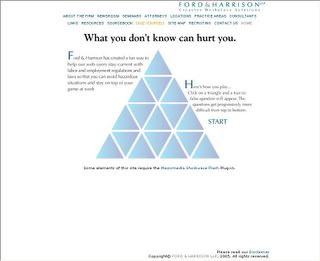
How well do you know your labor and employment regulations? Ford & Harrison developed a fun quiz to help HR pros stay on top of their game. Be warned, the questions get inceasingly difficult as you progress. Click on the screen shot to be taken to the quiz. Good luck!  Posted by Hello

Tuesday, May 03, 2005

Workplace Violence Checklist - How do You Score?

Preventing Violence: An Organizational Self-Assessment | workforce.com

How well is your company protected from workplace violence? Workforce Management recently offered a helpful checklist to see if your company has the proper safeguards in place. Check it out here. The well-being of your employees and organization may depend on it.

On Monday, May 9th, Astron Solutions' bi-weekly ezine, Astronology will be covering the topic of Preventing Sexual Harassment in the Workplace. Harassment of types can lead to violence. You can access the article on and after May 9th by clicking here.

Monday, May 02, 2005

Employers Risk Prosecution for Workplace Safety Violations

The New York Times > Washington > With Little Fanfare, a New Effort to Prosecute Employers That Flout Safety Laws

Organizations that have repeatedly violated workplace safety regulations may not be able to just pay a fine anymore. The government is in the process of a crackdown on repeat offenders who have extensive records of safety violations. As reported in The New York Times:

The initiative does not entail new legislation or regulation. Instead, it seeks to marshal a spectrum of existing laws that carry considerably stiffer penalties than those governing workplace safety alone. They include environmental laws, criminal statutes more commonly used in racketeering and white-collar crime cases, and even some provisions of the Sarbanes-Oxley Act, a corporate reform law.

The result, those involved say, should be to increase significantly the number of prosecutions brought against dangerous employers, particularly in cases involving death or injury.


Will this new initiative send a serious message to employers? Read the full article here.

Thursday, April 28, 2005

Retired Workers are Still Working

This just in from the Center of Media Research...

A newly released report, by the JWT Mature Market Group and ThirdAge, Inc. (an online survey of 1,680 adults 40+ years of age who currently work full- or part-time for pay), finds that personal fulfillment across all demographic groups is a very important factor in the decision to work in retirement. The report says that Baby Boomers and Aging Mid-lifers are working for more than pay. The new definition, now, of fully retired, does not mean not working.

42% of these groups say that plan to fully retire, but of those, 70% plan to work (13% full time, 32% part time and 26% occasionally)

The key reasons given for continuing to work are to:

Stay mentally active(74%)
Be productive or useful(63%)
Stay physically active (62%)
Be around people (55%)
Keep learning newthings (52%)


The eye-opening brief further explores how many older workers succumb to the pressure to look young by changing their appearance (hair color, clothing, etc.) View it in detail and get on the Center for Media Research mailing list by clicking here.

Wednesday, April 27, 2005

Homicide More Likely at Gun-friendly Workplaces

- Forbes.com

Forbes.com reported today that homicides are more likely at workplaces that allow guns. Well, that sounds about right. Read on...

Murders are three times more likely to occur in workplaces that permit employees to carry weapons than in workplaces that prohibit all weapons, new research finds.

And that risk doubles when the weapons are guns, says a University of North Carolina at Chapel Hill study.

The study, published in the May issue of the American Journal of Public Health, compared 87 cases where employees were killed at work sites in North Carolina between 1994 and 1998 with 177 comparable work sites where there were no murders.


The article explains that the reason why employers allow employees to bring weapons may be for their own protection. However, having a gun at work or at home, can lead to increased cases of homicide.

Tuesday, April 26, 2005

Workplace Stress? Cool Is The Rule

Trends Workplace Stress? Cool Is The Rule

Looking for tips for staying stress free at work? HR.com delivered five ways for you and your employees to stay cool as cucumbers. Author Don Phin stresses the fact that the human body is not designed to sit at a desk all day long. It's vital that employees get out from behind their computers, stretch and take a little time for themselves. Believe it or not, this leads to increased productivity. Read the article here.

Friday, April 22, 2005

Celebrating the 35th Anniversary of Earth Day


Today, April 22, is Earth Day. Although it hasn't gotten much press recently, the holiday is a important reminder for businesses to be environmentally responsible. The Canadian Earth Day site offers a detailed list on how your organization can do its part to help save the planet.  Posted by Hello

Thursday, April 21, 2005

Bigger Salaries for College Grads

Human resources answers now - HR.BLR.Com

Looks like it may be easier for graduates to pay off those college loans. According to a survey by the National Association of Colleges and Employers (NACE), recent college grads are seeing an increase in starting salaries. Overall, the average offer to liberal arts graduates is currently $30,337, up 4.2 percent from last year's average of $29,119.

Read the full story on BLR's site here.

Monday, April 18, 2005

Candy makes the workplace a little sweeter

News-Leader.com | Business | Jar-keepers fill workplace with sweets, happiness

Happy National Licorice Day! (Yes, there is a holiday for just about everything out there!) While we are on the subject of candy, Lifesavers came out with the results of their survey which explores the treatment of employees who keep candy dishes on their desks. The results are sweet for the candy providers and a bit sour for the moochers. According to Workbytes, News-Leader.com's workplace column by Dawn Sagario and Larry Ballard, the survey shows that 60 percent of those with candy dishes got raises last year, compared with fewer than half who would rather just dip into a co-worker's. However, the results show that a sugar fix brightens up the workplace for everyone...

"We know the candy dish is a fun part of life, but what the results of the survey have shown us is that candy dishes offer employees a simple, enjoyable way to break through everyday office obstacles and keep the lines of communication open," said Barry Sands, who is LifeSavers' "brand manager."


Although candy may be bad for your teeth and your waistline, it's great for company morale. Time to fill up the candy dish with a fresh pack of Twizzlers!

Read the entire Workbytes article here.

Thursday, April 14, 2005

New dot-jobs Internet domain to debut in 2005

New dot-jobs Internet domain to debut in 2005

Online recruiting and hiring has a new home on the Internet... and that home is ".jobs." SHRM and two partners have been given the permission to create the new top-level Internet domain. Website addresses sporting the new urls should start showing up online sometime in late summer / early fall.

Said SHRM President and CEO Susan R. Meisinger, SPHR: “Recruiting skilled, dedicated talent is among the strategic contributions HR professionals make to the success of an organization.” The new Internet domain “has the potential to create a more streamlined recruiting process for HR professionals and make it easier for prospective employees to find vacant jobs.”

“Once established, .jobs will do three things to make the current recruiting process better,” said Tom Embrescia, chairman of .jobs, in a prepared statement. “It will make the recruitment process simpler for companies to recruit; it will make recruiting uniform for all companies; and that means that job seekers will find the jobs faster and companies will be able to more quickly fill open positions.”

Read the full story here.

New Zealand Company Fined for Work Stress

The New Zealand Herald

A New Zealand company was fined for work stress after an employee was diagnosed with depression and hypertension that was determined to be directly caused by her working environment.

New Zealand's Occupational Safety and Health (OSH) Service's National operations Manager Mike Cosman said, "the mental and physical harm the woman suffered was the direct result of work pressures and poor work organization, which the company failed to deal with despite numerous complaints."

Nalder and Biddle is the first company in New Zealand convicted for failing to provide a safe work environment. Read the full story http://www.nzherald.co.nz/index.cfm?c_id=1&ObjectID=10120367.

Tuesday, April 12, 2005

Your Workplace is Dirtier Than You Think!

Inside Bay Area - On the Move

Think you work in a clean environment? Think again! According to a recent study of office workplaces in San Francisco, New York, Chicago, Atlanta and Tuscon, office equipment, such as mice, keyboards, and telephones, are crawling with germs.

The study, funded by the Clorox Co., looked for the presence of the human parainfluenza 1 virus, which can cause colds and respiratory infections. The results were surprising and well...pretty disgusting. Read on...

Forty-seven percent of desktops, 46 percent of computer mice, 45 percent of telephones, 26 percent of doorknobs and door handles, and 19 percent of light switches tested positive for the parainfluenza virus, the survey found.

"These are the high-touch, high-contact areas that tend to be germ zones or germ transmission points," said survey coordinator Charles Gerba, professor of environmental microbiology at the University of Arizona.

"It becomes more relevant if you share desk space," Gerba said. "Basically, anybody that has a cold or a flu, they are laying a mine field of viruses around the office.

"I think germs have figured it out — location, location, location," he said, noting that the virus can live for up to 72 hours on surfaces.


So which of the five cities topped the workplace germ list? Check out the rest of the article here.

The Passing of the Pope Results in Increased Religious Discussion

Pope's death brings religious discussions into the workplace

Religion and politics are known as two dangerous topics of conversation. The recent passing of Pope John Paul II has made religion the popular topic in the workplace, regardless of faith. This is normal and expected, however there is cause for concern if these conversations take a negative turn.

DailyBreeze.com recently explored the issue of religion in the workplace and offered suggestions for employers...

The federal government has set standards regarding religious expression in the federal workplace, and much of these apply to other workplaces as well. Here are some general rules to follow, adapted from "Guidelines on Religious Exercise and Religious Expression in the Federal Workplace" (updated March 22):

Employees should be permitted to engage in private religious conversations in such places as cafeterias and hallways to the same extent that they may engage in nonreligious private expression, subject to reasonable content and provided the conversation doesn't interfere with work duties.

However, employees must refrain from such expression when a fellow employee asks that it stop or otherwise demonstrates that it is unwelcome. For example, if one employee invites another employee to attend worship services at her church, and the other employee, already a devout adherent of another faith, asks that the invitation not be repeated, the first employee must not ask again.

Laws against workplace discrimination include religious discrimination. As such, employees cannot make derogatory remarks to other employees about their faith or lack of faith. This typically will constitute religious harassment.

Also, a person holding supervisory authority over an employee may not, explicitly or implicitly, insist that the employee participate in religious activities as a condition of continued employment, promotion, salary increases, preferred job assignments, or any other incidents of employment. Nor may a supervisor insist that an employee refrain from participating in religious activities outside the workplace except pursuant to otherwise legal, neutral restrictions that apply to employees' off-duty conduct and expression in general.


Read the rest of the article here.

Friday, April 08, 2005

Employers Confront Growing Confusion over Partner Benefits

Employers Confront Growing Confusion over Partner Benefits (3/05)

The issue of partner benefits continues to cause legal confusion. A recent article in SHRM Forum attempts to decipher the situation...

"As time has gone by, things have gotten muddier, rather than clearer, from a legal perspective," said Todd A. Solomon, a partner with law firm McDermott, Will & Emery LLP in Chicago, speaking March 14 at SHRM's Employment Law and Legislative Conference in Washington, D.C. "Particularly over the past 12 months, companies have faced a number of mixed messages with respect to how they should treat same-sex couples under their benefit plans."

Adding to the confusion, Solomon said, last year Massachusetts became the first (and so far, only) state to recognize same-sex marriages, entitling same-sex spouses to all marriage-related benefits under state employment laws. But last year 13 states also passed constitutional amendments declaring that only marriages between one man and one woman would be legally valid, and a similar amendment to the U.S. Constitution was introduced in Congress.

On March 16, Michigan Attorney General Mike Cox declared that the amendment his state passed in November now bars health care and other benefits for the same-sex partners of state employees.

Meanwhile, current domestic partner laws in New Jersey and California, and a civil union law in Vermont, afford same-sex couples most or all state-recognized spousal rights without recognizing same-sex marriages. But the 1996 federal Defense of Marriage Act (DOMA) bars same-sex spouses from receiving any benefits under federal statutes—from the Family and Medical Leave Act and ERISA regulations to the tax code. To date, 39 states have also passed their own statutory DOMAs that, while easier to amend or revoke than constitutional amendments, still define marriage as "one man and one woman" and bar recognition of same-sex marriages performed in other states. (Click here to link to a chart of statewide marriage laws.)

With some states extending employment law mandates to cover same-sex partners and spouses, while others (and the federal government) enact prohibitions, "juxtaposed against each other, these two trends add up to a lot of confusion about what's legally required, what's optional, and what benefit providers and insurers may be doing," Solomon told conference attendees.


SHRM members can read the entire article here.

Sexual Harassment by Non-Employees - Are You Liable?

HR Matters

As an HR professional, you are no doubtedly well-versed on your organization's sexual harassment policy. You've read all of the articles and have participated in the workshops...you are ready if a case of sexual harassmant occurs among your employees. But what if the harasser is a customer or vendor? Or worse yet, a client whose business is vital to the future of your organization?

From HR Matters...

Both the courts and the Equal Employment Opportunity Commission (EEOC) have found that an employer may be held liable for sexual harassment of its employees by someone outside of the organization, such as a customer or vendor.

Unfortunately, there is little guidance as to the extent of your duty in this area. Clearly, you may have a particularly difficult time addressing the problem if you depend on the harasser's organization for a large part of your business.

Still, you have an obligation to protect your employees by investigating the complaint and by attempting to resolve the situation satisfactorily with both the employee and the alleged harasser.

According to the EEOC Guidelines on Discrimination Because of Sex (found in 29 C.F.R. §1604.11(e)), an employer may be responsible for sexual harassment by nonemployees, such as customers or vendors, if two conditions are satisfied. First, you must either have actual knowledge of the harassment or reasonably should have known about the problem. Second, you must have failed to take immediate and appropriate corrective action.

The HR Matters article includes case studies, a free sexual harassment policy download, and suggestions on how organizations should handle violators while protecting their employees. Check it out here.

Tuesday, April 05, 2005

April 1-7 is National Laugh at Work Week

April 1-7 is National Laugh at Work Week

How often do you laugh at work? Laughter is proven to be "the best medicine" by releasing endorphins, which in turn, releases stress. In the workplace, laughter has also been shown to increase productivity, teamwork, and employee satisfaction.

For more on National Laugh at Work Week and how you can bring a dose of humor into your workplace click here.

Monday, April 04, 2005

Is the work ethic in America fading?

APP.COM - Changes are coming to the workplace

If you had a crystal ball to gaze into the future of your workplace, what do you think you'd see? Well, according to the World Future Society, as reported by the Asbury Park Press, you would see employees who care less about a paycheck and more about personal fulfillment. Read on...

The society says the implications are clear: "The new generation of workers cannot simply be hired and ignored. They must be nurtured, paid well and made to feel appreciated. Training is crucial. Without the opportunity to learn new skills, young people will quickly find a (new) job that will help them to prepare for the rest of their career."

As for those in the 30-plus age range — Generation X — the society notes that their continuing entrepreneurial spirit will affect large companies.

"Lifelong learning is nothing new (to Generation X). It's just the way that life is. Companies that can provide diverse, cutting-edge training will have a strong recruiting advantage over competitors that offer fewer opportunities to improve their skills and knowledge base. (They) have little interest in their employers' needs. They also have a powerful urge to do things their way."

And even with the growing use of technology allowing workers to get more done in less time, workers are finding the stress is increasing, as well.

"Stress-related problems affecting employee morale and wellness will continue to grow. Companies must help employees balance their time at work with their family lives and need for leisure. This may reduce short-term profits but will aid profitability in the long run," the society says.

For more details, check out the full article here.

Friday, April 01, 2005

To Your (Employees) Health!

Health care rates are still a cause of headaches. As reported in BenefitNews.com's Connect Newsletter...

Health care costs are moderating from last year's rates, but still rising by double digits in 2005 for most types of coverage, according to the semi-annual National Health Care Trend Survey conducted by Mellon.

Cost trends for 2005 are expected to range from 14.9% for indemnity coverage to 12.1% for those with HMOs. Cost for high-deductible consumer-driven plans -– defined in this survey as plan with a $1,500 deductible and a pharmacy benefit –- are projected to increase an average of 14.2%. Mellon survey is based on data provided by 83 insurers or health plan administrators in December 2004.

"Medical trend rates are coming down slightly, but they are still persistently high. It's a double-edged sword," says Harvey Sobel, a principal at Mellon and author of the report.

The top three reasons insurers gave Mellon why their medical trends dropped slightly from last year were improved financial results, better financial arrangements with doctors and hospitals, and a desire to be more competitive in the marketplace.


According to Mellon, the average cost per employee for healthcare increased 5% or $200, from 2004 to 2005.

Thursday, March 31, 2005

"I'm leaving to join the circus!" and other reasons why employees quit

Design News

Specialized staffing service, The Creative Group, recently conducted a survey to find out the unusual reasons why some people leave their jobs. The result is a light-hearted look at the very real issue of employee turnover.

Following are some of their responses:

“An employee left because he didn’t like the smell of the office.”
“One guy said he was making too much money and didn’t feel like he was worth it.”
“A worker didn’t like to use a computer and said the job wasn’t as glamorous as she thought.”
“A person left because she didn’t like the lighting in our building.”
“These results show you can’t please every employee all the time,” said Tracey Fuller, executive director of The Creative Group. “A certain amount of turnover is to be expected and may not be preventable. Conducting exit interviews can help managers determine whether a situation is unique or if there’s a workplace problem that needs to be addressed in order to discourage additional staff members from leaving.”

Read the full article here.

We here at Astron are wondering... what's the most unusual reason for leaving that you've heard?

Warning: You can be sued for unintentional age bias

Court: Workers can sue for unintentional age bias

If your work practices ultimately have a negative effect on employees over the age of 40, you are in danger of being sued.

From SHRM Online...

The U.S. Supreme Court ruled March 30 that the disparate impact theory of liability is available to employees suing under the 1967 Age Discrimination in Employment Act (ADEA), but the scope of employer liability on that basis is narrower than under Title VII.

The disparate impact theory allows plaintiffs to challenge an employer’s neutral practices that have a disproportionately negative impact on persons over the age of 40, so workers will be able to sue in some cases over employer actions that result in unintentional discrimination.

Click here to read the full story.

Wednesday, March 23, 2005

The Easter Bunny Arrives Early at New Zealand Company

Boss offers a golden Easter incentive | NATIONAL | NEWS | tvnz.co.nz

Steve Musson, Director of The Flooring Centre in New Zealand, gave 40 of his employees a special Easter treat this year. As reported by New Zealand's One News Network...

With record low unemployment around the country, attracting and keeping staff is becoming a real problem for companies wanting to expand.

But a Christchurch firm is trying to combat that by offering its workers a real incentive to stick around.

Steve Musson is taking over 40 of his flooring and carpet laying staff to the Gold Coast for Easter.

In the midst of a construction boom, the company noticed attracting and keeping staff was proving difficult so Musson decided to do something to keep his employees.

And Musson says his move has made it an exciting workplace. "Particularly with the trip so close now. A few of our people haven't been overseas before, so it's a real buzz for people like that."

While there will be a conference to attend and team building activities, they will also have time to visit theme parks and relax.

"The major positive that we've had already is that staff retention has been 100% - we haven't lost any staff since we made this announcement," says Musson.

The investment has been a large one for the flooring company but Musson hopes it will all be worth it.

"Ask me in a few months' time," laughs Musson.

Friday, March 18, 2005

How to Get Sued

The HRN Management Group just added another white paper to their already impressive library. This time, they are offering a few simple, easy to implement practices that can increase the odds that an employee will sue you.

"How to Get Sued" reminds readers to ask inappropriate interview questions, play favorites, and keep a "closed door" policy ("An Open Door Policy will only lead to the entrance of problems. You just can't control what walks in.")

Luckily, you can't get sued for overt sarcasm. Check out "How to Get Sued" and the rest of their white paper collection here.

Wednesday, March 16, 2005

Minimum Wage Proposal Shot Down

WorldatWork

It's been eight years since Congress last increased the minimum wage, and it looks like they aren't going to do it again anytime soon.

From The New York Times, by way of Workspan Weekly...

"Under a deal worked out between Republicans and Democrats, the wage amendments considered on Monday were all but doomed from the start because they required 60 votes to be adopted. It has been eight years since Congress last increased the minimum wage, which now stands at $5.15 an hour.

The Democratic proposal to increase the minimum wage by 41 percent, to $7.25, over the next two years was sponsored by Senator Edward M. Kennedy of Massachusetts. It was sought by organized labor and opposed by an array of business interests.

''The height of hypocrisy will be this afternoon, when those individuals in this Senate say no to a minimum wage increase of $7.25 an hour when this institution voted themselves a $28,500 pay increase over the last five years,'' Mr. Kennedy angrily declared shortly before the amendment was defeated as 49 members voted against it and 46 voted for it. ''Minimum wage has been flat all these years, but not for the members of this Congress.''

But Republicans denounced the measure, saying that it would do more harm than good.

''By raising minimum wage, you are pricing some workers out of the market,'' said Senator John E. Sununu, Republican of New Hampshire. ''It is an economic fact. Proponents of the minimum-wage increase like to dismiss this.''

Congressional aides said Mr. Kennedy would offer the amendment again in other legislation.

The Senate also defeated an alternative amendment by Senator Rick Santorum, Republican of Pennsylvania, that would have raised the minimum pay level by $1.10, to $6.25, over 18 months. Thirty-eight senators voted for the measure and 61 voted against it.

The proposal was supported by some business groups and opposed by organized labor because it would have eliminated overtime pay in many circumstances and excluded millions of workers now eligible for minimum wage and overtime provisions. The Santorum amendment also provided for about $4 billion in tax breaks for smaller businesses."

Tuesday, March 15, 2005

New Poster Requirement as of March 10th

Have you posted your new USERRA poster yet? All employers are required to notify employees of their rights under the Uniformed Services Employment and Reemployment Rights Act, USERRA.

The poster explains the rights and protections such as the right to re-employment after uniformed service, freedom from discrimination and retaliation for serving in uniform, and certain health insurance protections.

Get your poster here.

Protecting Identity...New Rules for HR

You can never be too careful when it comes to protecting your employees from identity theft. Read on...

From HR Matters, March 15, 2005, Volume 7, No. 11

"Rev up your shredders – a largely ignored provision of the 2003 Fair and
Accurate Credit Transactions Act (FACTA) now requires employers to
dispose of consumer report and credit information "properly." Beginning
June 1, 2005, any person who maintains or possesses "consumer
information" must be prepared to dispose of these records in a way that
ensures that the information will not be improperly accessed or used.

This requirement is one of many provisions in FACTA intended to protect
consumer privacy and to prevent identity theft. So, if you receive a
credit report or any other investigative report regarding an applicant
or employee, you should have a plan to dispose of that information in
the future."

For a free download of the eight-point checklist, "Beyond FACTA," click here.
To get FACTA facts, go to privacy rights.org.

Monday, March 14, 2005

Gen X dads are no slackers

Beacon Journal | 03/14/2005 | Gen X fathers more involved

Forget the old slacker stereotype, Generation X dads (ages 25 - 40) are proving that they are much more hands-on than previous generations, although they still aren't willing to accept help. From Knight Ridder newspapers:

Juggling roles as a business executive, father and coach is all in a day's work for men of Generation X. These new dads with new priorities represent a broad shift from prior generations in their level of involvement with their kids. And that involvement reflects in the workplace: They are more likely to sacrifice pay, modify work travel and refuse relocation for family reasons.

Now some employers are reaching out to help men with balance, considering them the silent stakeholder in the work/life debate. But those employers who try often are baffled by the results: The men are shunning benefits offered to them or reluctant to talk openly about work-family conflict, often out of fear of being perceived as weak in their commitment to work.

Fathers of Generation X -- the 60 million Americans between ages 25 and 40 -- spend at least an hour a day more involved in their child's lives than the prior generation.

Friday, March 11, 2005

Boeing's Ex-CEO Loses 2005 Bonus

This time the retirement is going to be a little different...

Boeing Co. announced yesterday that ousted CEO, Harry C. Stonecipher, who was having an "improper relationship" with a company executive, will receive his $2.1 million bonus for 2004, but is ineligible for a prorated bonus for 2005. On top of that, he has been removed from the Boeing incentive pool and will lose all company benefits and perks, such as use of the company aircraft, a company car, and customary office space.

Ironically, Boeing shares have risen 44% in the past year, attributed in part to the leadership of Stonecipher.

AQUENT's "Business of Touch" offers guidance to the confused business traveler

AQUENT - Business of Touch

Ahhh cultural diversity... it's a phrase that HR professionals know very well! It can also be the catalyst for some awkward moments, especially when it comes to greetings. Aquent has created an animated website that demonstrates appropriate business greeting etiquette in nine languages and fifteen countries. For example did you know that a greeting in France commonly consists of two to four kisses on each cheek? Or that shoving a business card in your pocket without looking at it is a sign of disrespect in Korea?

Check out the site before your next business trip, or when welcoming visiting foreign executives!

Stat Counter