Showing posts with label New York Yankees. Show all posts

Tuesday, November 23, 2010

What HR Can Learn From the Derek Jeter/Yankees Negotiations

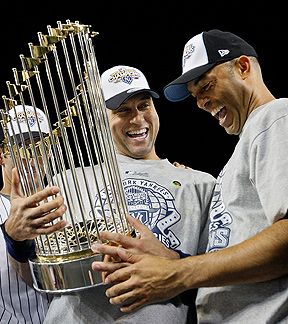
Being played out in the New York media is a very public contract dispute between an employee and an employer. This isn't strange--especially not for sports--where the New York Jets' Darrelle Revis (who already had a contract, mind you) had a long contract dispute before it was finally settled in equally public fashion. But there have been few contract negotiations quite like this one--a legend who embodies an organization fighting on the back pages with a legendary organization that demands professionalism and results from its employees. In the end, the Yankees need Jeter and Jeter needs the Yankees...but in the meantime, they're left to squabble it out to sports writers.
HardballTalk

But that doesn't mean that similar things don't go on in your own company. How many employees do you currently manage who are unhappy with their salaries but their loss would sting your company more than the financial outlay? How many employers have employees that they can probably do without but have meant so much to an organization that added financial incentive to stay around (and maybe as a reward for past results) may be appropriate? How many times does this situation become contentious and lead to a standstill between the perceived value of the employee and the offering value of the company?

The problem is that it doesn't look good from either side, but the employer has to figure a way to solve it before the problem spreads to other employees. Can you imagine if all the Yankees free agents were involved in this much of a public spectacle over the contract negotiations? If the Yankees were actually playing right now (and corporate America rarely has an off-season like baseball does) imagine the distraction this would cause--is the proposed cost savings worth it? The lesson here is not to pay employees just because they become disgruntled or to reward bad behavior, but sometimes a little extra pay (or other types of incentives) goes a long way to making sure a dispute does not get out of hand. As many people would find it weird to see Derek Jeter in anything other than Pinstripes, so you should find it weird to imagine your best employees working for one of your competitors.

Monday, July 19, 2010

Running a Business Like George Steinbrenner

George Steinbrenner was known as "The Boss" in his time owning the Yankees. When he passed away last week, Steinbrenner took with him a complicated legacy as an owner who produced championships but a boss who could torment his employees. He was at the same time charitable (he had a saying that if more than one person knows about a good deed you've done, you've done it for the wrong reasons) and a criminal (made illegal contributions to Richard Nixon) but always interesting. Today the New York Post went through how to succeed the Steinbrenner way, but while they have praised the man and the team's success, it's also helpful to note that "The Boss" was not always the ideal boss:

BE FOCUSED From the day George Steinbrenner bought the Yankees for $10 million until he permanently stepped down last week, the former shipping executive had one all-consuming goal: to win. And he seems to have spent pretty close to every waking minute thinking about how to make it happen — just ask the minions who fielded his constant phone calls, endured his tirades and his meddling, and spoke of his obsessive attention to every corner of the organization. And his focus never let up, even in the off-season.
“Winning is the most important thing in my life, after breathing,” he famously said.
That was just one of the pieces of advice put forth by the post article. The others included "work tirelessly", "don't be afraid to shift gears--even if you swore you wouldn't", "fire when ready", "be a boss, not a friend", "hire top talent, and pay them well", "demand results", "set clear goals", "never always criticize your employees in public", "pay attention to the little things", "don't give your stars preferential treatment", "build your brand", "have a heart OK", and "don't rest on your laurels". All of these are good advice for someone running a business and while George M. Steinbrenner III was very good at accomplishing some of these in a way that helps an organization, some of his actions certainly hurt his organization and his employees. A good balance is certainly needed for an organization to have successful leadership.

Thursday, November 05, 2009

Yankees Win, thhhhhheeeeee Yankees Win (and a few HR articles)


We don't hide our baseball loyalty very well here at the Astron Solutions blog. We're (Myself, Jennifer and Mike) big Yankees fans and we're gloating today after the Yankees took home #27! They were able to overcome controversy, weak areas and past failures to finally capture the biggest prize.

Love or hate the Yankees, you have to respect how well-run their organization is, regardless of the money. They put the right people in the right situations to succeed and pushed guys when they could be pushed. They stuck behind guys like Alex Rodriguez who had trouble outside the workplace and allowed him to succeed at the workplace. It's a good model for HR to replicate.

A few HR articles for you as I get ready to head to the Canyon of Heroes tomorrow:

  • Wired has an awful story about a woman losing her job because of an error in the FBI criminal database. Ouch.
  • Lastly, word today from The New York Times on the House of Representatives extending the jobless benefits.

Thursday, June 11, 2009

Sad Baseball Night In New York

A sad baseball night in New York as the Yankees and Mets both lose one-run games against their arch-rivals. So how about some great HR articles instead?

-CNN has a great article up on how significant others should react when their men get laid off -- but they still have a job. Some great advice there.

-24 Hours Vancouver is next with some advice not to lie on your resume because it'll come back to haunt you.

-Next, the Zanesville Times Recorder writes about mandated sick leave. It may not have passed in Ohio, but it is has a chance of becoming a national law.

-You have some questions for HR? Well the Atlanta Journal-Constitution has an "Ask HR"

-Lastly, Business Management Daily says that while HR salaries weaken, comp and benefit pays have grown.

Let's hope tomorrow is a better night for New York baseball...

Friday, August 08, 2008

"When Facial Hair Was as Rare as a Triple Play"

This New York Times baseball blog title was so good, we decided to use it as our own ;)

If you haven't read the Astronology or our post on facial hair in the workplace, you should: click here

We made a reference to the Yankees, and this article from the Times is a great little history of facial hair in baseball. The Yankees have had a policy under principal owner George Steinbrenner that has prohibited long hair of facial hair (besides a cleanly shaved mustache on the upper lip). Some other teams have also taken variations on it. If you incorporate a facial hair policy and meet resistance, you can tell your employee that you're just being like the Yankees!

Tuesday, July 08, 2008

Supporting NY and the 'Stache


We find it hard to disguise our love of baseball here on the Astron Blog and with both Mets and Yankees fans on the team, we decided to give some extra help to those teams. We've added on the right side of the blog, a voting widget so you can vote for whoever you want (or Jason Giambi of the New York Yankees and David Wright of the New York Mets). We're located in New York, but won't give away who we're voting for (Giambi and Wright).

Amazingly, the Yankees and the American Mustache Institute (not even remotely kidding) have endorsed Jason Giambi as the AL candidate: click here

Giambi's mustache has gotten so popular it's become an icon at the stadium: click here

And it even has it's own blog: click here

David Wright hasn't resorted to the 'Stache [yet], but we'll give him the nod, as well--for John.

It has nothing to do with HR...but we urge you to support New York...

Wednesday, June 18, 2008

Accountability in the Clubhouse

More on the Mets after Jennifer's great post...

The headlines aren't pretty: click here and here

And even Jon Stewart and the Daily Show have gotten into it:


And the articles about how poorly this was executed were numerous to say the least: click here and here and here and here and here and here and here and here (we'll stop here to be nice)

Willie Randolph's mother even got her opinion in here via the Journal News: click here

Journal News Beat Writer Peter Abraham thinks (and has thought) that the Mets need a Vice President of Common Sense: click here

But maybe one of the topics we need to be talking about, especially as HR Professionals, are how little accountability gets taken in this situation. The truth is that the easiest person to fire in sports is always the manager or head coach. But why wasn't it the owners faults? Or the players faults? Or, most glaringly, the General Manager's fault?

In sports (unlike a lot of other places in life) players cannot be simply and cheaply fired. In baseball, hockey and basketball you can waive or buy-out players but you still need to pay the entire amount of their contract. Football players can be waved but certain parts of salaries and bonuses still need to be paid and a certain salary cap hit still applies. Since most players that would actually change the tone of an underachieving team are the biggest stars, this can be an expensive and usually cost-prohibitive method. Trading a player is always an option but if a player is overpaid and underachieving you either get back another overpaid underachiever or pennies to the dollar in value for the guy you want to shed. A lot of marginal or young players end up getting moved because of the flexibility they retain in having a small contract. So the truth is that while the players have the largest impact by far on the end-product, and in a normal business they would be the first to go, the star players usually can escape the blame.

Owners don't fire themselves both in real life and on sports teams so that's out. But they write the checks and approve the deals and hire the General Manager, Manager and coaches.

General Managers seem to have a greater lifespan than managers (who also last longer than their coaches--who become sacrificial lambs at times). Omar Minaya showed that in this case. Minaya built the team and served as the axeman...but seemed to bear no responsibility in the end, even blaming the media in the end.

So it's the manager that goes and it brings up an issue for Human Resources: when things goes wrong and nobody is obviously solely to blame: who do you blame? who gets fired?

Many people feel like Minaya is next but the truth of the matter is that he should go just for how he handled the situation. Letting someone go is never easy to do but it should never be this difficult and drawn-out and messy and public. At this point, they are making the Yankees look like model citizens.

Wednesday, May 21, 2008

What I’m Hearing…Winning Interview Techniques

According to a recent British study, 84% of candidates bring something lucky with them to job interviews. The most common item? Lucky underwear, used by 60% of survey respondents. Interestingly, many of these 60% note that the lucky underwear they’re wearing are unwashed. Apparently, washing removes luckiness. Who knew? Now I know the error of my ways all those years. In addition to using lucky items, 73% of candidates check their horoscope before a job interview.

Here in New York, we’ve been hearing lots about New York Yankee Jason Giambi’s lucky gold thong underwear. Granted, baseball is a sport rampant with superstition, but “lucky” thoughts undoubtedly occur in your workplace on a daily basis.

As humorous as the British study may seem, I suspect the results are fairly accurate. I personally get a different feel and attitude from different outfits I own, and select my outfit for the day based on what I need to be successful with the particular audience or group I’ll see that day. This study can provide some interesting break time discussion, allowing you to learn more about your employees and what makes them tick. Along the way, they may also learn that it’s their own innate talents and expertise, and not a “lucky” coin, picture, or outfit, that makes them great.

In other news, Clearview Cinemas announced yesterday that they are going back to discounted tickets for children and seniors. The bad press and public outrage were too much. Score one for keeping the cost of living down.

Stat Counter