Showing posts with label benefits. Show all posts

Wednesday, May 30, 2018

Paid Time Off – Back to Basics

In a 2017 small business survey conducted by Justworks and Squarefoot, it was reported that less than half (44%) of employees felt that unlimited Paid Time Off (PTO) is important. Only about 28% work at organizations that offer unlimited PTO. This week in Astronology® we discuss the basics of PTO.

In general, PTO is identified as vacation, sick leave, and / or personal days; in other words, allotted paid time away from work. While in some cases employers designate a specific amount of days / hours for each reason for being away from work, this article will focus on policies that allow employees to earn a bank of paid time off, and then use the time as they see fit.

The majority of organizations provide employees with paid time away from work, even though it’s not legally required (with the exception of sick leave in certain states and major cities). Paid time off is considered an excellent recruitment tool. As explained by Chron.com, “…many job postings state that the company has a ‘generous vacation policy’ or ‘generous time-off policy’ to increase the company’s appeal to qualified applicants.” This is understandable as there has been an increased focus on work-life balance by the incoming generation of workers.

Two popular forms of awarding PTO are banked and accrued. Banked time is typically awarded at the beginning of the calendar or fiscal year. Accrued time is gained through a designated rate per days (and / or years) worked by the employee. Adds Chron.com’s small business website, “if an employee takes time off before accruing the hours, the time is unpaid. An employer may decide to cut employee compensation costs by reducing the number of PTO hours an employee can accrue.”

Some advantages to having a PTO policy include the following:

  • Managers are no longer put in the position of policing and reporting employees’ use of benefits.
  • Unscheduled absences are more controlled.
  • Employees have more flexibility of use (they can use the time to take care of a sick child, or go on a restorative beach day, for example).

Some disadvantages include the following:

  • In cases where paid time off is banked, an employee could save his / her PTO, and leave an organization with a balance of banked time for which the organization would then have to pay the employee.
  • Sometimes employees view PTO only as vacation time and will attend work while sick.

Humana, a medical insurance company, gives some suggestions regarding specific elements to consider when building a PTO policy:

  • Who is eligible for PTO? (Full-Time, Part-Time, Interns, All?)
  • How much PTO will be offered?
  • How does PTO time accumulate? (What is the rate? Will it be banked?)
  • How can PTO time be taken? (Hour increments? Full days?)
  • Can unused time carry over from year to year? If so, how much?
  • Can an employee opt to cash out his / her unused days?

The Humana website also suggests that “many employees don’t take vacation because they simply feel they have too much work to do. Creating a culture that prioritizes work-life balance must start from the top.” To avoid some of the disadvantages listed earlier, employers can begin to emphasize the need for proper work-life balance and encourage proper use of the organization’s PTO policy.

Does your organization have a robust PTO policy? Are you considering adjusting the policy to appeal talent in the coming years? Feel free to share your thoughts in the comment section below!

Tuesday, June 13, 2017

The Challenge of Misclassification in the Gig Economy

According to a 2016 Pew Research survey, some 24% of American adults have used some sort of digital commerce platform to earn money. This approach to earning a living is considered part of the gig employment phenomenon. In a 2016 study conducted by Harvard’s Lawrence Katz and Princeton’s Alan Krueger, 16% of American workers work for a temporary help agency, contract as independent contractors, or hold an on-call position. Current trends anticipate the gig economy to comprise more of the workforce in the future. In this issue of Astronology®, we look into the recent trend of gig employment and a critical challenge surrounding it.

In 2015, the Economic Policy Institute (EPI) reported that workers misclassified as independent contractors had grown considerably. Also stated in the report was that “New ‘sharing economy’ [also known as gig economy] businesses create cause for concern about misclassification because it is unclear how ‘autonomous’ these workers really are.” The report further expresses, “Employers who misclassify avoid paying payroll taxes and workers’ compensation insurance, are not responsible for providing health insurance, and are able to bypass requirements of the Fair Labor Standards Act, as well as the 1986 Immigration Reform and Control Act.”

A direct result of this misclassification is gig workers being forced to pay the full ACA tax or purchase their own health insurance. However, these costs may not be within their gig incomes. These conditions have given rise to lawsuits alongside the rise of gig-like jobs. For instance, Lyft recently settled a $27 million class-action lawsuit brought by drivers seeking to be classified as employees. Currently, Uber is in court for a similar class-action lawsuit. In light of this, the next question to consider is if labor laws will ever catch up to the rise of the gig industry.

Some employers have lobbied state legislatures to assist in legal coverage. In response, 28 states have legalized ride-hailing services, such as Uber and Lyft, labeling their workers as independent contractors. In Arizona, all workers using online labor platforms for work are considered independent contractors. This means that, while workers will find it hard to file successful claims for state-run benefit programs, gig workers still retain the right to sue over benefits and protections owed to employees under federal law. In New York and Washington, portable benefits, an encompassing benefit program designed for independent workers, are being considered.

As the workforce continues to change and more independent workers comprise our labor force, it will be important to see how legislatures continue to react. Do you work for an organization that supports or has some form of independent workers? How large a part of your organization are gig workers? How does your organization support gig workers? Please share your thoughts in our comments section below!

Tuesday, July 05, 2016

Save Your Employees from the Dark Side: Human Resource Lessons from Star Wars


Through George Lucas’ storytelling, filmgoers have come to know Darth Vader as the epitome of evil. But as viewers learn from the early 2000 Star Wars prequel trilogy, underneath that intimidating exterior beats the heart of a man whose turn to the dark side was largely a result of his frustration with his former employer.

What if the Jedi had an effective human resource program? Perhaps we would have seen Anakin chatting with Yoda over intergalactic eggnog at the Jedi holiday party, rather than Darth Vader bowing to the evil emperor in Revenge of the Sith.

So where did the Jedi’s HR program go wrong? At first glance, there doesn’t appear to be a problem. After all, the Jedi offer an excellent training program for new employees, surely making them one of the galaxy’s employers of choice. Where else can you learn how to wield your very own lightsaber and do Jedi Mind Tricks? They don’t offer that type of training even at Microsoft.

Concerned for employees’ futures, wise companies are.

In Revenge of the Sith, we see that Anakin, now a Jedi Knight, has become one of the Jedi’s “star employees.” However, even though Jedi Knight is a highly respectable title, Anakin is unhappy regarding his entry level status. He desperately wants to be promoted to Jedi Master believing that this new title would bring him the respect that he feels he deserves. What Anakin doesn’t seem to understand is that each Jedi Master has years of solid experience and knowledge of The Force under his or her belt. As a result of this disconnect, Anakin becomes increasingly frustrated and considers another job offer.

“A Career Progression program could have helped in this situation,” explains Michael Maciekowich, National Director, Astron Solutions. “Building career paths lets employees know that they are moving forward within an organization, giving them a sense of direction. Anakin would have realized that the Jedi cared about his career growth, and that the promotion to Jedi Master was an attainable goal, had there been a clear career progression program in place.”

Communicate you must.

As the story unfolds, we see that there is also a serious lack of communication between Anakin and the Jedi’s upper management, the Jedi Council. In fact, Anakin reveals to his wife that he feels lost and doesn’t believe that the Jedi Council trusts him.

“The Council could have considered a First Impression Survey, which is given to employees within their first few months of employment. This is a crucial time to provide integration into the organizational culture, encourage open communication, and let new employees know that you value their feedback,” says Jennifer C. Loftus, MBA, SPHR, PHRca, GPHR, SHRM-SCP, CCP, CBP, GRP National Director, Astron Solutions.

Offer great benefits, you should.

One major reason why Anakin eventually turns to the Dark Side is because he believes that they offer better “benefits” (and we don’t mean a good dental plan). The confused, young Jedi is concerned that he is going to lose someone close to him due to medical reasons, and believes that his new position will offer him the “ultimate” in healthcare insurance. As he quickly learns, however, his new employer wasn’t exactly truthful about the health coverage.

Perhaps the Jedi weren’t clearly communicating their own benefit plan to Anakin. Increased communication and attention to employee feedback could have helped in this situation as well.

“When choosing from the vast array of benefit offerings, it is important for HR professionals to analyze their employees' needs. The Jedi Council should have asked their employees what standard and voluntary benefits would be of most value to them and work to make those benefits available,” explains Loftus. It may be too late for Anakin / Darth Vader, but it’s not too late to save your own employees from the Dark Side. Remember, you don’t need The Force to make your team happy, just solid HR programs.

Sunday, January 23, 2011

Cleaning Out the Links Part 3

We start out on this Monday morning with 18 common e-mail mistakes from US News and World Report via Yahoo! Finance (H/T Sarah). I can tell you from the experience of receiving e-mails (in both my professional and personal life) that people hit reply all way too often when they just mean to hit plain ole reply.

Next, from FINS we have Goldman Sachs updating their interview tips via a nifty little video (H/T Wendy). The most important advice, in my opinion, is the last point: "At the End. Ask two or three questions about the company or about the interviewer's view of broad industry trends. Don't ask about salary and benefits. You'll have plenty of time for that once you get an offer. And, of course, e-mail a thank you note. It's a classy touch."

ABC News is next with some things not to do during an interview such as, well, bringing mom. Some of these are priceless.

Next, from USA Photos Pictures Blog is a list of the top ten worst jobs in the United States...with pictures of each.

Lastly, from SIFMA, a list of what the positions really mean in simpledetails.

Thursday, August 26, 2010

More About Disgruntled Workers

Last week we talked about Steven Slater here at the Welcome to the World of HR blog, but obviously he's not the only disgruntled worker out there. Let's take a look at a few other articles:

First we have the other "famous quitter" of this past week, "Jenny" who quit her job via job erase board "leaked" to The Chive. The whole thing ended up being a farce, but Jenny became as big of a cult hero as Slater for a few hours. What does it show when Slater and "Jenny" become "working class heroes"? People are frustrated at their current jobs.

With that in mind, Slate tells us that employers should be glad that candidates won't take their crummy, low-wage jobs, even in a bad economy: "Hiring is a negotiation between employers and employees over the terms at which they'll agree to come to work—wages, benefits, working conditions, length of commute, relocation requirements. Maybe some of these employers just aren't offering terms that are good enough."

TLNT follows by telling us that even people who have jobs aren't ready to settle for those crummy, low-wage jobs and that 40% of workers are going to be ready to find a new job this fall.

Lastly, we have a Wall Street Journal Careers Q&A where someone asks about quitting a job...before they've even started.

The lesson of all this: make sure that your current co-workers and you candidates are, well, "gruntled"

Friday, April 02, 2010

Unemployed...and Frustrated

On this Good Friday, we bring you some good links that are not so good if you're unemployed:

It's frustrating when you go through a few interviews and don't get a job offer. But one person went through 52 interviews at Goldman Sachs and got only one job offer according to Here Is The City (H/T Wendy). Wow

How many people are taking jobs right now they are overqualified for? But it doesn't mean they aren't really happy to be employed according to the New York Times (H/T Sarah and picture from the NYT article)

There is one time when "any work" is worse than "no work": unemployment benefits and the Christian Science Monitor via Yahoo! explains (H/T Wendy)

And Tom Delay, you have egg on your face after saying that people are unemployed because they want to be. Details of that non-PC and non-true statement from Huffington Post via Yahoo! (H/T Wendy)

Thursday, December 10, 2009

When Personal Information Gets Out

My company sent around an e-mail today that let us know our benefits administrator inadverently sent out personal benefits enrollment information (including Social Security numbers) to the Human Resources department of another client.

Now that the damage has been done, what can the company do to make it right? The benefits administrator is sending a letter home to all of us explaining the mistake and also offering one free year of credit monitoring. But is that enough?

One co-worker who had learned about this type of situation in her past job said that this was insufficient: "Thieves sit on the information for a while due to the fact they know people will be monitoring and then start using when they think the coast is clear--usually after one year."

Now "luckily" this information was only sent to a another Human Resources department and the e-mails were supposedly all deleted without being read. But what if this was accidentally (or purposefully) sent to people who were not as honest? Not only is the associates' information at risk, but their families who are enrolled in the benefits are at risk as well.

This just goes to the heart of the issue: make sure that all safeguards are in place to assure that your employees' personal information never gets into the wrong hands. And if it does somehow get into someone else's hands, you need to make sure there are measures in place to correct the situation.

Do you think that our benefits administrator has done enough in this situation? What do you think they could do more (another year of monitoring, etc.)? What measures does your company have in place for this type of situation?

Tuesday, November 24, 2009

Losing Disability Benefits Because of Facebook/Chippendales

The Lede from The New York Times had this as a title: "Depressed Woman Appears Happy on Facebook, Trouble Ensues."  When you read through the story (first reported from CBC News), it's another lesson to employees to watch what you post on sites like Facebook:
A 29-year-old Canadian woman who says she’s too depressed to do her job claims that her employer’s insurance company stopped paying her disability benefits because she posted some photographs of herself on Facebook in which she appeared to be happy.
Nathalie Blanchard, who has been on sick leave from an IBM office in Quebec since “she was diagnosed with major depression” 18 months ago, called her employer’s insurance company, Manulife, to ask why she had stopped receiving her monthly check. Ms. Blanchard says that an insurance agent informed her that photographs she had posted on her Facebook account — showing her apparently enjoying a Chippendales show, her birthday party and a beach vacation — proved that she was not depressed
Now I can't see how this can stand (but then again I don't know the Canadian court system that well). I'm not sure an insurance agent is qualified to tell if a woman is depressed or not based on photos she posted on Facebook. And if she was enjoying Chippendales, her birthday and a beach vacation, isn't she a normal human being. Let's just say things got worse for Blanchard after this...
[Her lawyer, Tom Lavin] told The Gazette, a Montreal newspaper, that his client’s mortgage insurance was cut off because someone alerted her financial institution to the supposedly damning Facebook photos. “That forced her to sell her house because she can’t afford to pay her mortgage,” Mr. Lavin told The Gazette, “her credit has gone down the tubes and her reputation has been damaged. She’s not having a good time.”
If she wasn't depressed before...Ouch.

Thursday, November 05, 2009

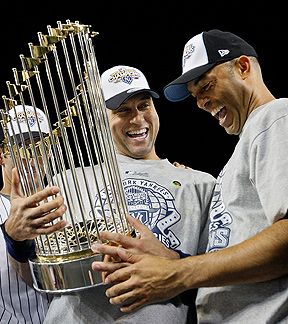
Yankees Win, thhhhhheeeeee Yankees Win (and a few HR articles)


We don't hide our baseball loyalty very well here at the Astron Solutions blog. We're (Myself, Jennifer and Mike) big Yankees fans and we're gloating today after the Yankees took home #27! They were able to overcome controversy, weak areas and past failures to finally capture the biggest prize.

Love or hate the Yankees, you have to respect how well-run their organization is, regardless of the money. They put the right people in the right situations to succeed and pushed guys when they could be pushed. They stuck behind guys like Alex Rodriguez who had trouble outside the workplace and allowed him to succeed at the workplace. It's a good model for HR to replicate.

A few HR articles for you as I get ready to head to the Canyon of Heroes tomorrow:

  • Wired has an awful story about a woman losing her job because of an error in the FBI criminal database. Ouch.
  • Lastly, word today from The New York Times on the House of Representatives extending the jobless benefits.

Monday, October 26, 2009

Don't Report Your Time Off?

WorldAtWork recently posted a blog entry titled: "Vacation time: Is It Time to Stop Tracking?" It's an interesting question and one which has a lot of different answers depending on who you ask. From WorldAtWork:
Many companies over the years have migrated from siloed leave policies that designate a specific number of days for vacation, sick leave and personal time off to paid time off (PTO) banks programs that provide a total set number of days off that employees can use for any reason. Newer, even more flexible, programs now provide employees with more informal personal time and vacation arrangements with their managers when it suits them, guided mainly by their ability to perform their jobs successfully.
Now this is much like an honor system, and like any honor system, you have the chance of abuse or free riders. But the idea makes sense. With people permanently tethered to Blackberries and the internet, the job doesn't have to stop when you leave the office. If people don't abuse the system, they'll get their job done and be happy, which should increase productivity even more. I once interviewed for a job that was run like this, though they expected you to make up for the time you missed...but you could miss as much as you wanted.

Some companies allow you to trade time off credits, work a Saturday/Sunday to get another day off, or other similar ways to make time off more flexible for the employees.

The problem here is this is not for every job. You still need to know when people are going to not be at their desks--especially in service-oriented companies--and reporting time off (or at least letting their managers know ahead of time) is one way to accomplish that. This also can only occur at companies where the management and the employees feel secure with one another. Employees have to feel comfortable enough with taking the time off (since there are issues with them feeling that way as it is) and employers need to feel comfortable enough in the fact the job will get done and the person will not abuse it.

But in the world of increasing attachment to the office, allowing an employee to have the ultimate "flex" time off doesn't mean they'll truly be away from the job and could be another "benefit" that separates your company from the rest when recruiting new employees.

Question to the audience: do any of your companies do this? what are your opinions on the subject?

Wednesday, September 02, 2009

What I'm Hearing...Customized Rewards

Over the next two months, I'm going to be on the road giving presentations on total rewards. Hopefully among my travels I'll come across some blog worthy discoveries!

One of the key themes of my presentations is that, in today's economy, employers can't rely solely on base pay and benefits to attract and retain employees. Rather, total rewards is the new focus. Total rewards includes pay and benefits, and also adds work/life balance, career advancement and development, and performance management and recognition into the mix. Moving forward, organizations will have to tap into all 5 of these areas, and customize their blends to meet employee needs, in order to be successful.

In light of this I found two separate conversations I had yesterday quite interesting. In both instances, the employees' employers were trying to do something nice to reward their employees by tapping into the 3 new elements of total rewards. In both cases, the employees knew how much their company was spending on the "reward," and would rather have had the cash. They felt like their companies were forcing the "reward" on them.

Customization of rewards is key moving forward. To be done right, however, customization must be done from the perspective of the employee, not the employer. To truly reward and motivate, the compensation elements must be what the employee wants and needs, not what I as your manager think you should have because I happen to like it.

How much rewards customization does your organization use? Is it truly customized? How will your rewards programs change moving forward?

Thursday, June 11, 2009

Sad Baseball Night In New York

A sad baseball night in New York as the Yankees and Mets both lose one-run games against their arch-rivals. So how about some great HR articles instead?

-CNN has a great article up on how significant others should react when their men get laid off -- but they still have a job. Some great advice there.

-24 Hours Vancouver is next with some advice not to lie on your resume because it'll come back to haunt you.

-Next, the Zanesville Times Recorder writes about mandated sick leave. It may not have passed in Ohio, but it is has a chance of becoming a national law.

-You have some questions for HR? Well the Atlanta Journal-Constitution has an "Ask HR"

-Lastly, Business Management Daily says that while HR salaries weaken, comp and benefit pays have grown.

Let's hope tomorrow is a better night for New York baseball...

Tuesday, April 21, 2009

Patriot Day Links

In was Patriot Day up in Boston today and here are some links to celebrate:

-The Laconic Law Blog tells us how making a profane comment about your employer can result in your loss of labor protections

-Don't have time for social media? Collegerecruiter.com say to hire an intern!

-HR World says less structure, more profit and to do this they recommend hiring recent graduates and having them work in a virtual office.

-RoundPegg has some thoughts on brown-nosing, sycophantism and sucking up including urging us all to not give in

-Want to know how a company can blow its trade secret protection? George's Employment Blawg has some details

-Goals vs. Commitments. Fistful of Talent has the battle

-Lastly, Benefits Buzz urges it to be done pro bono to get the most from time off spent to volunteer

Monday, October 06, 2008

Hiring and Firing

The Atlanta Journal-Constitution starts us off with an article about whether you should dress business casual for an interview: click here

A Human Resource Management Solutions article following up on a HR World article for our next entry on five quick hiring tips: click here

The Houston Business Daily has next for us a Human Resources Guide to employment issues resulting from Hurricane Ike: click here

The Gazette of Colorado Springs says that everyone, especially the employer, benefits by handling layoffs fairly and honestly: click here

Lastly, the Orlando Business Journal cites a study that says that most workers are puzzled about their benefits: click here

Wednesday, September 03, 2008

The HR Executive and the Election

We start off on this Wednesday smack in the middle of the convention cycle and with an article from Human Resource Executive Online saying to brace yourselves for whoever is elected president: click here

Human Resource Executive Online also wants to talk about where HR stands today and who Human Resources Executives want as president and why: click here

Next, the Business Ledger tells HR professionals how sloppy Human Resources adds to employers' benefit costs: click here

Human Resource Management Solutions by People Wise then asks when does a small business need an Employee Handbook: click here

The Courier Post Online follows up by saying that you should take time to think if job is lost: click here

The Hartford Courant ends our post with an article that tells us that sometimes, following your heart works: click here

Tuesday, May 20, 2008

Wall Street and Astronology

It's Astronology Tuesday (another Super Tuesday)...and while we encourage you to click on the link on the right and check out the newsletter, we have some other articles on our blog this Tuesday...

First from the Wall Street Journal, an article that states that relocation benefits are often negotiable: click here

Next, also from the Journal, some warning to Human Resources that when the job market improves, job hopping will heat up: click here

Lastly, Human Resources Blog, a division of Labor Law Center, has some Q&As about FMLA in small office (click here) and unfair treatment and wage manipulation (click here)=

Monday, May 05, 2008

Employers as Babysitters

Happy Cinco de Mayo!

First, we have an article from US News and World Report's "The Inside Job" which says that although employers end up playing babysitter for their employees, they're increasingly getting in trouble for doing so: click here

This is a very interesting view on the situation which, in effect is saying to Americans "grow up"

Next, from Human Resources Executive Online, an article about what workers want from the President: click here

Also, from the Salt Lake Tribune, word on what happens if you hire undocumented workers and get caught: click here

Lastly, from a blog that is titled "Team Building is for Suckers", a question of "where in the world is SHRM [the Society for Human Resource Management]"? click here

Thursday, April 24, 2008

Blogroll Pt. 2

We're on to part 2 of 3 of reviewing our Blogroll here at Astron Solutions World of HR blog...

We start with Jim Stroud who changed the name of his blog from JimStroud to "The Recruiters Lounge" and has a new look and a new address but the same great information: click here

Also in recruiting is the Recruiting Fly Blog which today gives some diversity resumes and interview advice: click here

We have another WorldAtWork blog here for Ryan Johnson who has a lot of interesting topics including this one about Performance Reviews from a few weeks ago: click here

The HR Capitalist has a lot of interesting topics (Human Resources and not), but this recent one provides a scenario if the author had a few million dollars...they would aggregate references of a candidate: click here

And last on this list is the Industry Radar which has given us a few nice links on their website and has some great HR news on Benefits, Retirement, Health, among other topics: click here

Thursday, January 10, 2008

Don't Make Work Your Primary

Although it may be Primary time, the New York Times starts us out by letting you know that making it's time to take a Secondary look at talking about your politics or wearing your campaign button at work, among other topics in this Q&A: click here

We go back to the New York Times for an old article still prescient about job growth fading fast: click here

The Business Review (Albany) has an article which says that telecommuting can hurt office morale: click here

From the Boston Globe's BostonWorks Ask The HR Expert we get some answers in this Q&A about Benefits and Compensation: click here

Next, from HR Daily Advisor, they post the question: Is coaching the new management? click here

Lastly, some HR Management news from Occupational Health and Safety has news that the Society for Human Resources Management (SHRM) President/CEO is about to retire: click here

Stat Counter